2K Double Color Tail Light Injection Mould Production Process
author: Lily Huang 0086 18989682282
2024-09-10

In today’s competitive automotive industry, vehicle lighting systems are not only functional elements but also integral to a car’s design and brand identity. Among these, tail lights have evolved dramatically—featuring stylish contours, innovative light guides, and increasingly, double color designs. At the heart of producing such complex and aesthetically appealing components lies the 2K double color injection moulding process.
What Is 2K Double Color Injection Moulding?
2K injection moulding, also known as two shot moulding, is a manufacturing process where two different materials or colors are injected into a mould to create a single integrated component. In the case of tail lights, this often means combining a transparent lens with a colored or reflective housing—delivering both function and design in one solid piece.
This technology is especially critical in the production of modern LED tail lights, where complex structures, precise optical performance, and aesthetic integration are key. The 2K process improves not only product quality and assembly efficiency, but also design flexibility.
Step-by-Step Production Process of 2K Tail Light Injection Mould
1. Design & Engineering Analysis
The process begins with product design, often provided by automotive OEMs. Engineers use advanced CAD software to analyze the design and simulate the flow of materials, cooling time, shrinkage, and warpage. Since tail lights involve optical clarity and tight tolerance, meticulous attention is paid to every detail.
At this stage, collaboration between product engineers and mould makers ensures that the design is both functional and manufacturable using the 2K process.
Key deliverables at this stage:
Product 3D model
Mould flow analysis
DFM (Design for Manufacturability) report
Gate and runner design
2. Mould Design & 3D Modeling
Once the product design is approved, mould engineers start crafting the mould design. A 2K mould typically consists of two sets of cavities or rotating mechanisms to facilitate the two injections.
There are two common methods:
Rotary Platen Type: The mould or core rotates 180° between injections.
Core Back Method: A movable core retracts after the first injection to make space for the second.
Critical components in the design include:
High precision cores and cavities
Cooling channels to manage temperature differences
Interlocking and sealing mechanisms
Ejector systems designed for optical surfaces
CAD/CAM software is used to generate 3D models, which are then simulated for mechanical strength and thermal behavior.
3. Mould Tooling and Machining
With the mould design finalized, manufacturing begins. This involves precision machining of the mould steel, typically P20, H13, or S136, depending on the material and transparency requirements.
Processes involved:
CNC Milling: For the main blocks and components
EDM (Electrical Discharge Machining): For complex shapes and tight tolerances
Grinding and Polishing: Especially critical for lens areas to ensure optical clarity
Fitting and Assembly: All components are assembled with micrometer precision
Tail light moulds often require mirror polishing (SPI A1 grade) for lens clarity and advanced venting systems to eliminate air traps during injection.
4. First Injection (Primary Material)
After mould assembly, the process begins with the first injection, typically a transparent PC (polycarbonate) or PMMA (acrylic) to form the outer lens of the tail light.
Key parameters:
Injection pressure and speed
Mould temperature (carefully controlled for clarity)
Cycle time optimization
After the first material is injected, the mould core rotates or shifts to the second position to prepare for the next shot.
5. Second Injection (Secondary Material)
The second material—usually a colored PC, ABS, or another compatible thermoplastic—is injected into the newly available cavity space. This forms the housing, reflective elements, or decorative color features.
Challenges include:
Ensuring bonding strength between the two materials
Preventing contamination or color bleed
Maintaining perfect alignment
Advanced machines from brands like Engel, Arburg, or KraussMaffei are often used for their ability to manage dual injection systems with high precision.
6. Cooling and Ejection
The part is then cooled using optimized cooling channels embedded in the mould. Tail light parts often have thicker sections or optical features that demand uniform and controlled cooling to avoid warpage and internal stress.
Once cooled, the part is ejected using a soft ejection mechanism to protect the optical surfaces.
7. Post-Processing and Inspection
After demoulding, parts undergo:
Visual inspection for defects, bubbles, or flash
Dimensional inspection using CMM or laser measurement
Optical testing for light transmission and refraction
Color matching and surface clarity evaluation
For premium vehicles, the tail light lens must meet automotive lighting standards (SAE, ECE), requiring high transparency, no visible flow lines, and perfect alignment between the two materials.
Benefits of 2K Moulding for Tail Lights
Seamless Integration: Eliminates the need for gluing or welding two separate parts.
Enhanced Aesthetics: Allows for smooth transitions between colors and shapes.
Better Sealing: Minimizes potential water ingress between parts.
Higher Strength: Fusion of materials enhances structural integrity.
Cost Efficiency: Reduces labor, assembly time, and secondary processes.
Why Choose a Professional 2K Mould Manufacturer?
The complexity and precision required for automotive 2K moulds mean not every mould maker is equipped for the task. A professional 2K injection mould manufacturer should offer:
In-house engineering team
Advanced CNC and EDM equipment
Cleanroom assembly for optical parts
Experience in automotive lighting
Global delivery and support
Choosing the right mould supplier is critical for ensuring on-time delivery, long mould life, and consistent product quality.
The 2K double color tail light injection mould production process represents a fusion of design, engineering, and manufacturing precision. As tail lights continue to evolve into design-defining features of modern vehicles, mastering 2K moulding technology is essential for automotive suppliers and OEMs.
From product design to post-mould inspection, every step in the process demands exacting standards and advanced capabilities. For manufacturers looking to enter or grow in the automotive lighting market, investing in 2K injection moulding is not just a trend—it’s a necessity.
If you're seeking a reliable and professional partner for 2K tail light injection moulds, ensure they bring not only the technical tools, but also the automotive industry experience and quality-first mindset that this complex process requires.
2K double color Tail light mould Manufacture with more then 20years experience,plesae check more details in our website for-Video
Headlight Optical Lens Mold Trial
Automotive Injection Molding Guidelines
Related Article

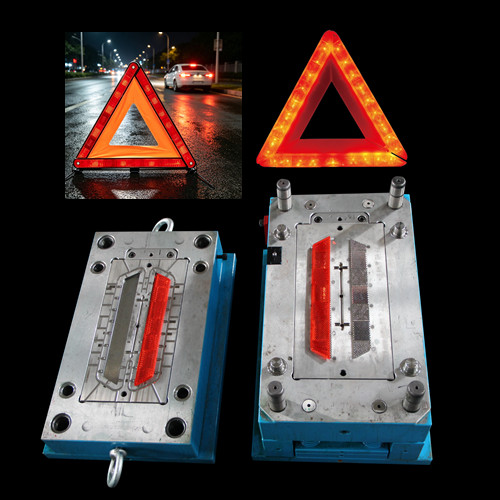
We are a professional mold manufacturer in Huangyan, China, specializing in high-precision injection molds for parking reflex reflectors and warning triangles. Our molds are made with durable steel for long service life, supporting custom designs and stable mass production to meet your automotive accessory manufacturing needs.
Parking reflex refletcor warning triangle mould