What Is Bulk Molding Compound (BMC)?
2026-01-12
When engineers, automotive designers, or injection molding professionals search “what is bulk molding compound bmc,” they're rarely looking for a textbook definition. Instead, they want to understand why BMC is the material of choice for demanding applications like automotive lighting—especially in components such as headlamp reflectors.
1. What Is Bulk Molding Compound (BMC)?
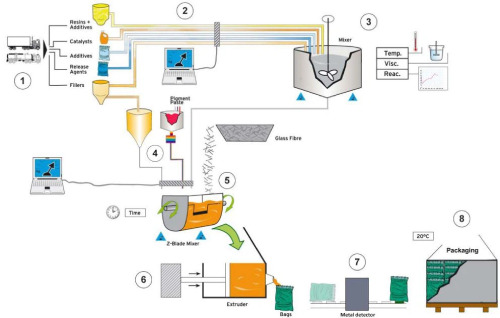
Bulk Molding Compound (BMC) is a ready-to-mold, glass fiber-reinforced thermoset polymer blend typically composed of unsaturated polyester resin, styrene, fillers (like calcium carbonate or alumina trihydrate), initiators, and up to 30% chopped glass fibers. Unlike thermoplastics that melt and re-solidify, BMC undergoes an irreversible chemical cross-linking reaction during molding (curing), resulting in a rigid, dimensionally stable part that won't deform under heat.
This thermoset nature gives BMC three critical advantages for high-performance applications:
High heat deflection temperature (often exceeding 250°C), essential for headlamps exposed to intense light sources.
Excellent electrical insulation, making it ideal for connectors, switch housings, and EV components.
Low shrinkage and warpage, crucial for maintaining optical precision in bmc reflector mold cavities.
Unlike Sheet Molding Compound (SMC), which is rolled into sheets, BMC is supplied as a putty-like bulk material, fed directly into compression or injection-compression molds. This allows for more intricate geometries—such as the parabolic curves and micro-features found in automotive reflectors—without fiber orientation issues that plague other composites.
For industries where part consistency and long-term reliability are non-negotiable, BMC isn't just an option—it's the standard.
2. Why BMC Dominates Automotive Lighting: The Science Behind the Headlamp BMC Mold
Among the most demanding applications for BMC is the automotive headlamp reflector. Here, material performance intersects with optical physics. The reflector must maintain a near-perfect surface finish (often Class A or mirror-like post-plating) to direct light precisely according to regulatory beam patterns (e.g., ECE or SAE standards). Any warpage, sink mark, or fiber readout can scatter light, reducing visibility and failing compliance tests.
This is where BMC's formulation shines. Its low coefficient of thermal expansion (CTE) ensures minimal dimensional drift during curing and in-service thermal cycling. The fine particle size of fillers and controlled fiber length (typically 3–6 mm) prevent surface defects that would interfere with subsequent metallization (e.g., aluminum vacuum deposition).
But material alone isn't enough—mold design is equally critical. A headlamp bmc mold must account for BMC's high viscosity and exothermic curing reaction. Traditional steel molds with precise temperature zoning, venting channels, and surface polishing down to Ra < 0.05 µm are essential. Cooling must be uniform to avoid internal stresses that cause post-mold distortion.
Specialized molders like Younger Mould have developed proprietary cooling strategies and gate designs specifically for BMC reflectors, ensuring consistent replication of micro-optical features across millions of cycles. Their focus isn't just on making a mold—it's on engineering a system that harmonizes material flow, heat management, and surface fidelity.
3. Evaluating BMC Molding Manufacturers: What Technical Capabilities Truly Matter
When sourcing bmc molding manufacturers, such as Younger Mould, buyers often fixate on price or lead time—but the real differentiators lie in process control and metrology. High quality BMC reflector production demands:
Material handling expertise: BMC must be stored cold and mixed homogeneously to prevent premature curing or filler settling.
Precision mold temperature control: ±2°C uniformity across the cavity is often required to avoid warpage.
In-mold sensing: Pressure and temperature sensors help validate each shot's consistency.
Post-mold inspection: Coordinate measuring machines (CMM) and optical profilometers verify reflector geometry and surface roughness.
Not all manufacturers invest in this infrastructure. Some treat BMC like standard injection molding, leading to flash, voids, or inconsistent plating adhesion. Others lack experience with optical-grade finishes, resulting in reflectors that require costly rework.
For automotive or aerospace clients, certification (IATF 16949, ISO 13485 for medical) often serves as a baseline indicator of process maturity. But deeper due diligence—such as reviewing cavity pressure data or surface finish validation reports—is what separates capable partners from vendors who simply run the material.
4. Beyond Headlamps: Emerging Applications for BMC in EVs, Electrification, and Smart Lighting
While bmc reflector mold technology matured in traditional automotive lighting, BMC's role is expanding rapidly. In electric vehicles (EVs), it's used for battery housings, busbars, and DC-DC converter enclosures due to its flame retardancy (achieving UL 94 V-0 without halogens) and electrical tracking resistance.
In smart lighting, BMC enables compact, heat-resistant housings for integrated LED modules with sensors and drivers. Its dimensional stability ensures optical alignment remains intact over 10,000+ hours of operation. Even in consumer electronics, BMC appears in high end projector reflectors and heat sink-integrated housings.
This versatility stems from BMC's tunable formulation. By adjusting resin chemistry, filler type, or fiber content, manufacturers can optimize for thermal conductivity, dielectric strength, or surface gloss—without changing the core molding process.
As lighting systems grow more complex and electrification accelerates, BMC's blend of mechanical robustness, thermal resilience, and moldability ensures it will remain a cornerstone material—especially where failure is not an option.
FAQ: Addressing Common Queries About BMC and Reflector Molds
Q: What is bulk molding compound (BMC), and how is it different from regular plastic?
A: BMC is a thermoset composite reinforced with glass fibers and fillers. Unlike thermoplastics, it cures permanently under heat and pressure, offering superior heat resistance and dimensional stability.
Q: Why is BMC preferred for reflector molds over other materials?
A: BMC provides low warpage, high thermal resistance, and a smooth surface finish—critical for maintaining optical precision in headlamp reflectors after metallization.
Q: What should I look for in bmc molding manufacturers for lighting applications?
A: Seek partners with experience in optical-grade surfaces, mold temperature control, and validation capabilities (e.g., CMM, surface roughness testing). Automotive-grade certifications are a strong indicator.
Q: Can a headlamp BMC mold be used for both halogen and LED reflectors?
A: Yes, but LED reflectors often demand tighter tolerances and better surface finishes due to smaller light sources and stricter beam control—requiring more advanced mold design.
Q: How does a bmc reflector mold differ from standard injection molds?
A: BMC molds require higher clamping forces, specialized venting for gas release during curing, and polished cavities to achieve optical surface quality. They're also designed for compression or injection-compression processes, not standard injection molding.
Understanding “what is bulk molding compound bmc” isn't just about knowing its ingredients—it's about recognizing how its unique properties solve real engineering challenges in lighting, electrification, and beyond. For professionals navigating material selection or mold sourcing, depth of knowledge—not marketing claims—determines project success. And in high-stakes applications like automotive reflectors, that depth is non-negotiable.
The Purpose of BMC
Does Die Casting Use a Permanent Mold?
Related Article

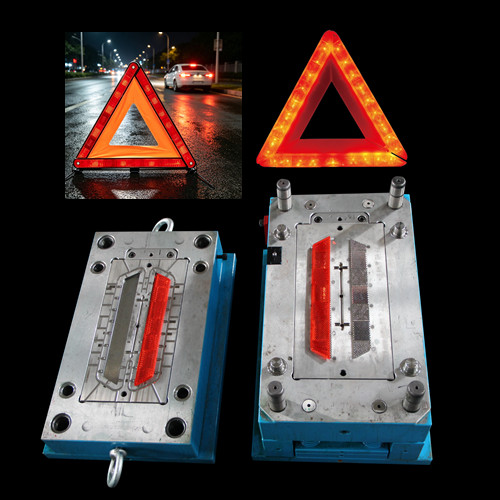
We are a professional mold manufacturer in Huangyan, China, specializing in high-precision injection molds for parking reflex reflectors and warning triangles. Our molds are made with durable steel for long service life, supporting custom designs and stable mass production to meet your automotive accessory manufacturing needs.
Parking reflex refletcor warning triangle mould