Can 6061 Aluminum Be Die Cast?
2025-12-12
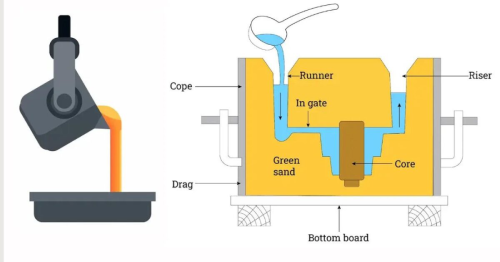
6061 aluminum, renowned for its excellent strength to weight ratio, good machinability, and superior weldability, has long been a staple in industries ranging from aerospace to automotive,especially automotive die cast mould. It's the alloy of choice for structural brackets, heat sinks, enclosures, and custom machined housings—particularly where post fabrication operations like welding or anodizing are required. However, “Can 6061 aluminum be die cast?”This isn't merely an academic curiosity—it's a practical crossroads with real world consequences across multiple dimensions.
Why 6061 Aluminum Is Not Suitable for Conventional High Pressure Die Casting
6061 aluminum belongs to the 6xxx series—an alloy primarily strengthened through magnesium and silicon, offering excellent weldability, moderate strength, and good corrosion resistance. It is a go-to material for structural parts, heat sinks, and automotive brackets fabricated via extrusion or machining. However, 6061 aluminum cannot be effectively processed using standard high pressure die casting due to its narrow solidification range and high hot tear susceptibility.
In HPDC, molten metal is injected at high velocity into a steel die casting mould design under pressures exceeding 10,000 psi. The process demands alloys with high fluidity, low melting points, and resistance to thermal cracking during rapid solidification. Alloys like A380, A383, or ADC12 are engineered for this—they contain higher silicon content (7–12%), which lowers viscosity and improves mold-filling capability. In contrast, 6061's low silicon content (~0.6%) and high magnesium content result in poor castability: it solidifies unevenly, leading to severe hot tearing, porosity, and inconsistent mechanical properties.
Moreover, 6061's solidus liquidus temperature gap (~50°C) is too wide for die casting's rapid cooling cycle. This promotes micro shrinkage and interdendritic cracking—defects that compromise part integrity, especially in thin walled or complex geometries common in automotive lighting components.
Alternative Manufacturing Routes for 6061-Like Performance in Cast Parts
Given the limitations of 6061 in HPDC, engineers seeking similar mechanical or thermal characteristics must consider alternative alloys or processes.
Option 1: Use HPDC Compatible Aluminum Alloys with Post Casting Treatments
While A380 doesn't match 6061's weldability or T6 temper strength, it can be heat treated or surface finished to approach comparable performance in non-structural applications. For heat sink applications—such as those in motorcycle headlight housings—A380's thermal conductivity (~96 W/m·K) is sufficient when paired with optimized fin geometry and airflow design.
Option 2: Switch to Low Pressure or Gravity Die Casting
For parts requiring 6061-like properties, low pressure die casting (LPDC) or gravity die casting offers slower solidification, reduced turbulence, and better control over microstructure. These processes are commonly used for high integrity automotive wheels or suspension components and can accommodate higher-strength alloys. However, they come with higher cycle times and costs, making them less suitable for high volume lighting parts.
Option 3: Reconsider Design Requirements
Sometimes, the insistence on 6061 stems from legacy designs or over specified material requirements. A collaborative die casting mould design review with an experienced China die cast mould supplier can reveal whether functional goals (e.g., thermal dissipation, weight reduction, EMI shielding) can be met with castable alloys through geometric or surface enhancements—without compromising performance.
Designing High Performance Aluminium Die Casting Molds for Automotive Lighting
For applications like die casting heat sink moulds for motorcycle headlights, the choice of alloy is just one factor. Equally critical is the aluminium die casting mold itself—its cooling channels, ejection system, venting strategy, and surface finish all influence thermal management, dimensional accuracy, and production longevity.
Companies like Zhejiang HuangYan Younger Mould Factory specialize in automotive die cast mould solutions that balance metallurgical constraints with functional demands. Their expertise includes:
Integrating conformal cooling channels to manage solidification gradients in heat-sensitive zones;
Using high grade H13 or SKD61 tool steel with nitriding or PVD coatings to withstand thermal fatigue;
Applying mold flow simulation to predict fill patterns, air entrapment, and potential hot spots;
Delivering weekly project reports with photo documentation to ensure transparency in mold development.
Rather than forcing 6061 into an incompatible process, such suppliers work with clients to select the optimal alloy-mold combination—ensuring the final component meets thermal, optical, and durability targets while remaining cost-effective at scale.
FAQ: Addressing Common Queries About Aluminum Die Casting and Mould Design
Q1: Can 6061 aluminum ever be used in any type of die casting?
Technically, 6061 can be cast using specialized processes like squeeze casting or vacuum-assisted HPDC, but these are niche, expensive, and rarely used for lighting components. Standard HPDC remains unsuitable.
Q2: What aluminum alloy is best for die-cast heat sinks in automotive lighting?
A380 remains the industry standard due to its balance of fluidity, strength, and thermal conductivity. For higher-performance needs, alloys like A360 (lower iron content, better ductility) may be considered—but with trade-offs in castability.
Q3: How does mould design affect the thermal performance of a die cast heat sink?
Automotive die cast mould design directly impacts wall thickness uniformity, fin integrity, and surface roughness—all critical for heat dissipation. Poor venting or cooling can cause porosity or warpage, reducing thermal efficiency.
Q4: Why choose a China die cast mould supplier for automotive projects?
China hosts a mature ecosystem of aluminium die casting mold manufacturers with advanced CNC, EDM, and metrology capabilities. Suppliers like Younger Mould combine cost efficiency with engineering rigor, offering full cycle support from design validation to trial molding.
Q5: Is it possible to anodize die cast aluminum parts like 6061?
Standard HPDC alloys (e.g., A380) contain high silicon and iron, which can lead to uneven anodized finishes. If surface aesthetics or corrosion resistance are critical, consider post-cast coatings or alternative processes like sand casting with 6061.
So, while “Can 6061 aluminum be die cast?” has a clear technical answer—no—this limitation opens the door to smarter material-process-system design. By partnering with knowledgeable China die cast mould suppliers and leveraging advanced die casting mould design principles, automotive engineers can achieve performance goals without compromising manufacturability. The key lies not in forcing a material into an incompatible process, but in rethinking the entire system around what die casting does best.
Why Add Salt And Soda To Molten Aluminum?
Two Types of Die Casting
Related Article

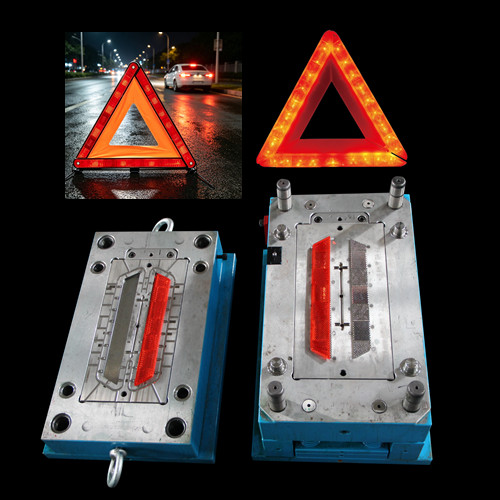
We are a professional mold manufacturer in Huangyan, China, specializing in high-precision injection molds for parking reflex reflectors and warning triangles. Our molds are made with durable steel for long service life, supporting custom designs and stable mass production to meet your automotive accessory manufacturing needs.
Parking reflex refletcor warning triangle mould