Can Injection Molding Be Used For Metals?
When most people hear the term injection moulding, they immediately think of plastic parts — from bottle caps to automotive dashboards. The process is widely known for its ability to produce high volumes of consistent, complex plastic components efficiently. But a common question arises in manufacturing circles: can injection moulding be used for metals? The short answer is no — not in the traditional sense. However, there is a closely related and highly effective process that achieves similar results with metal: die casting.
Why Traditional Injection Moulding Isn't Suitable for Metals
Plastic injection moulding works by melting thermoplastic pellets and injecting them under high pressure into a mold cavity, where they cool and solidify into the desired shape. The process relies on materials that melt at relatively low temperatures (typically between 160°C and 300°C) and flow easily into intricate mold designs.
Metals, on the other hand, have much higher melting points — aluminum melts at around 660°C, and steel exceeds 1300°C. Attempting to "inject" molten metal in the same way as plastic would require extreme pressures and temperatures that standard plastic injection machines and molds cannot withstand. Additionally, molten metals are more viscous and prone to oxidation, making controlled flow and defect free filling significantly more challenging.
Therefore, while the fundamental idea of shaping material in a mold is shared, traditional plastic injection moulding cannot be directly applied to metals. Instead, a specialized process — die casting — fulfills this role.
Die Casting: The Metal Equivalent of Injection Moulding
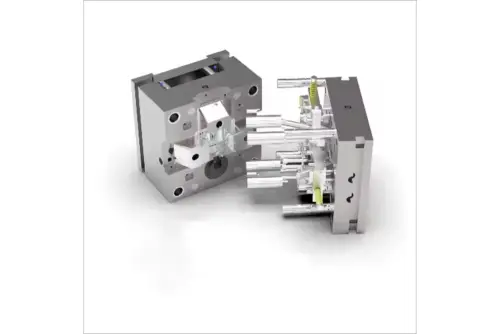
Often described as the metal counterpart to plastic injection moulding, die casting involves forcing molten metal — most commonly aluminum, zinc, or magnesium — into a steel mold cavity under high pressure. Once cooled, the part is ejected, and the cycle repeats. This method allows for the production of complex, dimensionally accurate metal components with excellent surface finish and tight tolerances.
Because of its similarities in workflow and repeatability, die casting and injection moulding are frequently compared. Both use reusable molds (dies), operate in high volume production environments, and rely on precise temperature and pressure control. However, the tooling materials, machine design, and cooling requirements differ significantly due to the extreme conditions involved in handling molten metal.
For example, a die cast aluminum mold must be made from high grade tool steel capable of withstanding thermal cycling, erosion, and mechanical stress over thousands of cycles. These molds often include advanced cooling channels, ejector systems, and venting mechanisms to ensure consistent quality and longevity.
Key Applications of Die Casting in Modern Industry
Die casting is widely used across industries where lightweight, strong, and intricately shaped metal parts are required. Common applications include:
Automotive components: engine blocks, transmission housings, brackets, and sensor enclosures
Consumer electronics: laptop frames, heat sinks, and camera housings
Industrial equipment: pump housings, connectors, and valve bodies
Aluminum is one of the most popular materials in die casting due to its favorable strength to weight ratio, corrosion resistance, and thermal conductivity. As a result, demand for precision die cast aluminum mold solutions continues to grow, especially in electric vehicles and renewable energy systems.
The process is particularly effective for medium to high volume production runs, where the initial tooling cost is offset by low per-unit costs and minimal post processing requirements.
The Role of a Professional Die Casting Mold Company
Creating a reliable and durable die cast mold is a complex engineering task that requires expertise in materials science, thermal dynamics, and precision machining. This is where a specialized die casting mold company plays a critical role.
Such companies are responsible for designing and manufacturing the steel dies used in the casting process. Their work includes:
CAD / CAM based mold design with flow simulation and stress analysis
CNC machining, EDM (Electrical Discharge Machining), and surface finishing
Integration of cooling lines, ejector pins, and overflow systems
Testing and validation through trial casting runs
A well designed mold ensures consistent part quality, reduces defects like porosity or hot cracking, and extends tool life. For manufacturers aiming to produce high integrity metal components, partnering with an experienced die casting mold company is essential.
While companies like Younger Mould focus on precision tooling and mold development, the emphasis in this space remains on technical excellence and long term performance rather than short term gains.
Comparing Die Casting with Other Metal Forming Processes
It's worth noting that die casting is not the only method for shaping metal. Alternatives include sand casting, forging, and metal 3D printing. However, each has its trade offs:
Sand casting is more suitable for large, low volume parts but lacks the dimensional accuracy of die casting.
Forging produces very strong parts but is limited in geometric complexity.
Metal 3D printing offers design freedom but remains costly and slow for mass production.
In contrast, die casting strikes a balance between complexity, precision, and scalability — making it the preferred choice for many high volume metal components.
Clarifying the Line Between Plastic and Metal Molding
While injection moulding cannot be used directly for metals, the concept lives on through die casting — a process that shares the same core principle of shaping material in a reusable mold under pressure. The distinction between die casting and injection moulding lies in the materials, machinery, and engineering requirements, but the goal remains the same: efficient, repeatable production of complex parts.
For industries relying on metal components, understanding the capabilities of die cast aluminum mold technology and the role of a qualified die casting mold company is crucial. As manufacturing continues to evolve, the integration of simulation, automation, and advanced materials will only enhance the precision and efficiency of these processes — ensuring that metal parts meet the demands of tomorrow's technology.
Younger Mould is a reputable die casting mold company in China, known globally for our dedication to quality, innovation, and reliability. We specialize in precision engineered die cast aluminum mold and offer tailored solutions to meet diverse project requirements—always at competitive prices. Share your contact information, and our team will promptly connect with you to discuss your specific needs. Contact us quickly!
Bicycle pedal reflector mold trial
What Are The Three Types of Rapid Prototyping?
Related Article