Can Optic Lens Be Injection Molded?
The question “Can optic lens be injection molded?” appears frequently in engineering forums, procurement inquiries, and R&D discussions—especially as industries from automotive lighting to consumer electronics seek cost effective, scalable alternatives to glass optics. The short answer is yes: modern optical injection molding can produce high-performance plastic lenses that rival glass in clarity, weight, and design flexibility. But the real story lies in the how—the stringent material, tooling, and process controls that separate functional optics from flawed prototypes.
The Science Behind Optical Injection Molding: Why It's Possible—and Challenging
Plastic optic lenses have been injection molded for decades, but early attempts often suffered from haze, distortion, or inconsistent focal performance. Today, advances in resin chemistry, mold precision, and process science have transformed optical injection molding into a reliable manufacturing method for applications ranging from motorcycle headlights to smartphone proximity sensors.
The key enabler is the availability of optical-grade thermoplastics—primarily polycarbonate (PC), polymethyl methacrylate (PMMA), and cyclic olefin copolymer (COC). These materials offer:
High light transmittance (>90%)
Low birefringence (minimal polarization distortion)
Excellent thermal stability
Impact resistance far superior to glass
However, these benefits are only realized when the molding process is meticulously controlled. Unlike structural parts, optical lenses cannot tolerate:
Residual stress (causes birefringence and beam deviation)
Surface defects (scratches, flow lines, or orange peel)
Internal voids or sink marks (scatter light)
Contamination (dust or degraded polymer causes haze)
Achieving optical quality demands more than a standard injection press—it requires a closed-loop system integrating ultra-clean material handling, precision temperature control, and real-time cavity pressure monitoring.
The Critical Role of the Optic Lens Mould in Determining Final Performance
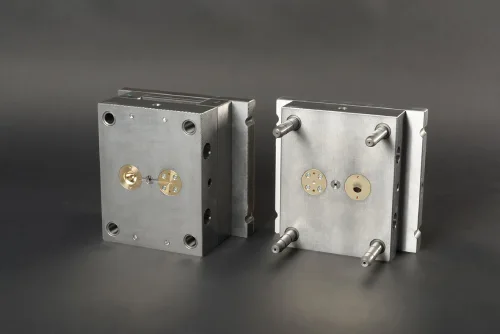
Many assume that once the right resin is selected, the lens quality is guaranteed. In reality, the optic lens mould is the single most influential factor in optical performance. A poorly designed or manufactured mold will imprint defects that no process tuning can fully correct.
A high precision optic lens mould must meet several non-negotiable criteria:
Surface Finish: Cavity surfaces are polished to SPI-A1 or better (Ra < 0.01 µm) using diamond paste or electropolishing. Even sub-micron scratches can scatter light.
Geometric Accuracy: Aspheric or freeform surfaces must be machined to tolerances within ±2–5 µm. This often requires 5-axis CNC machining followed by hand-finishing by skilled opticians.
Thermal Management: Thick-wall lenses—common in automotive projector headlights—require conformal or baffle-based cooling to prevent uneven shrinkage. Traditional straight cooling lines create thermal gradients that induce stress.
Gate Strategy: Gates are placed outside the functional optical zone. Film gates or hot runner pinpoint gates minimize weld lines and flow marks in the clear aperture.
Venting: Micro-vents (often 0.01–0.02 mm deep) allow air to escape without flashing, preventing burn marks or incomplete fill.
These requirements explain why only specialized optical lens mould factories can consistently deliver tooling for demanding applications. General-purpose mold shops lack the metrology, polishing expertise, and optical validation protocols needed.
Industry Applications Driving Demand for Precision Optical Injection Moulding
The adoption of optical injection moulding is accelerating across multiple sectors, each with unique performance thresholds:
Automotive & Motorcycle Lighting: Projector lenses, LED light guide strips, and thick-wall DRL (daytime running light) covers must meet ECE or SAE photometric standards. A 1% drop in transmission can cause beam pattern failure.
Consumer Electronics: Smartphone camera covers, proximity sensors, and facial recognition windows require high clarity and scratch resistance—often with anti-reflective or anti-fingerprint coatings applied post-molding.
Medical Devices: Endoscope lenses, diagnostic instrument windows, and surgical lighting components must be molded in ISO Class 7 cleanrooms to prevent particle contamination.
AR/VR and LiDAR: Emerging applications demand micro-lens arrays and freeform optics with sub-micron positional accuracy—pushing the limits of current molding technology.
In all these cases, the mold is not just a shaping tool—it’s an extension of the optical design. A lens that performs perfectly in simulation may fail in reality if the mold introduces stress or surface error.
Why Specialized Optical Lens Mould Factories Are Becoming Strategic Assets
As optical systems grow more complex, OEMs are shifting from transactional mold procurement to long-term partnerships with technically capable optical lens mould optical lens mould factory. These facilities offer more than steel—they provide optical engineering support, mold flow simulation with birefringence prediction, in-house validation (e.g., interferometry, haze testing), and dedicated production lines for transparent parts.
For example, in China—a hub for automotive and two wheeler lighting—optical lens mould factory like Younger Mould have developed focused expertise in thick wall optics and transparent light parts for both motorcycle and automotive headlight systems. As noted on their technical page, they operate a dedicated production line specifically for optic lens mould development, including projector lenses, LED light guide strips, and multi-color headlight housings. Their capability in two-color and three-color optical molds—where clear lenses are overmolded with tinted or opaque frames—demonstrates advanced alignment and thermal control.
Importantly, such factories treat optical molding as a system: material selection, mold design, process validation, and final inspection are integrated under one roof. This vertical approach reduces risk and accelerates development—critical in fast-moving markets like electric motorcycles or smart lighting.
Injection Molding as a Viable, High Performance Path for Optic Lenses
So, can optic lenses be injection molded? Absolutely—but only when the entire value chain is optimized for optical performance, not just mechanical form. Success hinges on the synergy between optical grade resins, ultra-precision optic lens mould tooling, and tightly controlled optical injection moulding processes.
As industries demand lighter, smarter, and more integrated lighting and sensing solutions, the role of specialized optical lens mould optical lens mould factory will only grow. For engineers evaluating manufacturing options, the question is no longer if plastic optics can be molded, but who has the technical depth to mold them right.
Younger Mould is a leading China optical lens mould factory specializing in high quality optical injection molding solutions. With a reputation built on innovation, precision, and reliability, we provide customized mold services that meet the specific needs of global clients. Our engineering team ensures every optical injection moulding is designed with advanced technology, delivering consistent performance, fast turnaround, and exceptional accuracy—helping manufacturers achieve efficiency without compromising on quality.
What Is the Difference Between a Mold for Lighting?
Automotive plastic parts mold manufactory in China
Related Article