What Is a BMC Injection?
2026-01-23
A common point of confusion among engineers, product designers, and procurement specialists lies in the terminology: when users search “What is a BMC injection?”, they're often conflating BMC (Bulk Molding Compound) with conventional thermoplastic injection molding. In reality, custom BMC molding is almost never processed via standard injection—it's typically molded using compression molding or injection compression hybrid methods due to its high viscosity and thermoset chemistry. Yet the misnomer persists, revealing a deeper need: clarity on how BMC is actually formed, why the process matters for critical components like automotive reflectors, and what distinguishes capable best bmc mold factories from general-purpose tool shops.
1. What Is a BMC Injection?
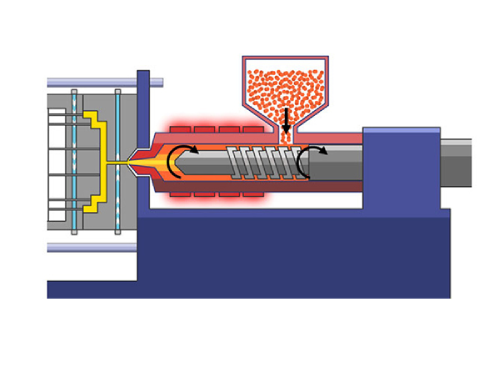
Despite widespread use of the phrase “BMC injection,” true injection molding of Bulk Molding Compound is rare and technically problematic. Custom BMC molding is a thick, dough like thermoset composite filled with up to 30% chopped glass fibers and mineral additives. Its high viscosity—orders of magnitude greater than molten thermoplastics like ABS or polycarbonate—makes it unsuitable for standard screw-driven injection units, which would overheat or shear the material unevenly.
Instead, most BMC parts are produced via compression molding: pre-weighed “shots” of BMC are placed into a heated mold cavity, which is then closed under high tonnage. The heat triggers an exothermic cross-linking reaction, curing the resin permanently into a rigid, dimensionally stable part. For complex geometries like reflectors, a modified injection-compression technique may be used, where BMC is briefly “injected” into a slightly open cavity before full compression—improving flow without sacrificing fiber integrity.
This distinction matters because the process directly impacts part quality. Poorly controlled compression can trap air (causing voids), create weld lines, or lead to uneven cure—disastrous for optical surfaces. Hence, when sourcing custom bmc molding, understanding the actual method—and the mold maker's command of it—is more important than semantic accuracy.
2. Why BMC Molding Demands Specialized Tooling?
Among the most exacting applications for BMC is the automotive headlamp reflector. Unlike structural housings, reflectors must maintain optical-grade surface fidelity to direct light precisely according to regulatory beam patterns. Even micron-level deviations can scatter light, reducing road illumination or failing ECE/SAE compliance.
This places extraordinary demands on both material formulation and bmc injection molding tooling. The mold cavity must be polished to a mirror finish (often Ra < 0.05 µm) and engineered with uniform cooling channels to prevent thermal gradients that cause warpage during cure. Venting must be precise to allow gas escape without flash, and gate/runner design—especially in hybrid injection-compression systems—must minimize flow marks.
Moreover, BMC's exothermic reaction generates internal heat that can accelerate wear on standard mold steels. High-performance toolmakers use hardened, corrosion-resistant alloys like 1.2343 ESR (a premium hot-work steel) to ensure longevity over thousands of cycles. They also conduct mold flow analysis not just for fill patterns, but for pressure distribution and weld line prediction—critical for reflector clarity.
Factories like Younger Mould, with decades focused solely on automotive lighting molds, exemplify this specialization. Their process includes weekly machining reports, cavity validation via CMM, and mold trials under production-like conditions—standard practice in top-tier best bmc mold factories, but rare among general mold suppliers.
3. Evaluating Custom BMC Molding Partners: Technical Signals Beyond Price Quotes
When companies seek custom bmc molding for reflectors or electrical components, they often receive quotes from a mix of general plastic molders and niche BMC specialists. The difference lies in invisible capabilities:
Material handling protocols: BMC must be stored at low temperatures and batch-mixed to prevent premature curing or filler settling. Facilities without climate-controlled prep areas risk inconsistent shots.
Process validation: Leading shops use in-cavity pressure and temperature sensors to log every cycle, ensuring repeatability—essential for automotive PPAP submissions.
Surface finish control: Achieving a platable surface without post-machining requires mold polishing expertise and cleanroom-adjacent assembly to avoid dust embedment.
Another red flag is mislabeling. A supplier advertising “BMC injection molding” without clarifying compression or hybrid methods may lack true BMC experience. Conversely, those who discuss cure kinetics, exotherm management, and cavity venting depth likely understand the material's behavior.
For global sourcing, location matters less than process maturity. Ningbo-based firms like Younger Mould have built reputations not through marketing, but through consistent delivery of multi-cavity reflector molds that pass OEM optical and durability tests—proof that capability, not geography, defines the best bmc mold factories.
4. The Future of BMC Molding: From Lighting to Electrification and Beyond
While automotive headlamps remain a flagship BMC application, the material's role is expanding rapidly. In electric vehicles, BMC's high comparative tracking index (CTI > 600V) and flame retardancy (UL 94 V-0 without halogens) make it ideal for battery busbars, fuse boxes, and charging connectors. In industrial lighting, it enables compact, heat-resistant housings for high-output LED arrays.
This evolution demands even tighter integration between material scientists, mold designers, and process engineers. For instance, new BMC grades with higher thermal conductivity are emerging—but they require re-optimized mold cooling strategies to avoid sink marks or residual stress.
As a result, the bar for custom bmc molding continues to rise. Success no longer hinges on making a part that “looks right,” but on delivering components that perform reliably under thermal cycling, electrical load, and optical precision—over 10,000+ hours of real-world use.
FAQ: Addressing Common Misconceptions About BMC Molding
Q: What is a BMC injection? Is it the same as plastic injection molding?
A: No. BMC is almost always compression-molded due to its thick, fiber-filled nature. “BMC injection” is a misnomer—though some use hybrid injection-compression for complex parts.
Q: Why can't standard injection molds be used for BMC?
A: BMC's high viscosity and curing chemistry require heated molds, high clamping force, and specialized venting—unlike thermoplastic processes that rely on cooling to solidify.
Q: What makes a factory one of the best bmc mold factories?
A: Look for experience with optical surfaces, use of hardened mold steels (e.g., 1.2343), mold flow analysis capabilities, and validation protocols like weekly machining reports.
Q: Can BMC reflectors be used with both LED and halogen headlamps?
A: Yes, but LED systems demand higher surface precision due to smaller light sources—requiring more advanced mold finishing and process control.
Q: How long does custom bmc molding take for a headlamp reflector mold?
A: Typically 8–12 weeks from final design approval, depending on complexity. Reputable shops provide weekly progress updates and T0 trial reports.
Car Light BMC Mold Manufacturing
The Purpose of BMC
Related Article

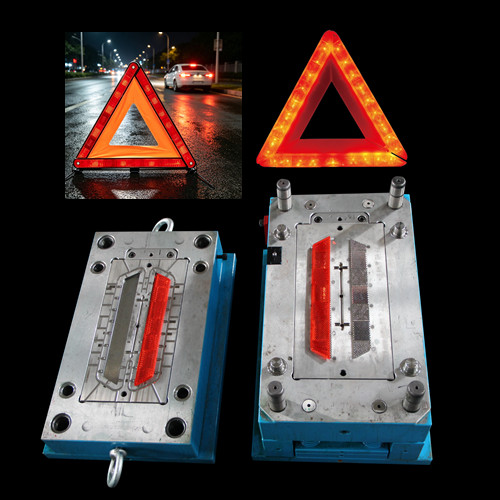
We are a professional mold manufacturer in Huangyan, China, specializing in high-precision injection molds for parking reflex reflectors and warning triangles. Our molds are made with durable steel for long service life, supporting custom designs and stable mass production to meet your automotive accessory manufacturing needs.
Parking reflex refletcor warning triangle mould