How Many Types Of Plastic Moulding?
2024-06-28
Plastic molding involves pouring liquid plastic into a specific mold or container where it solidifies into a customized shape. These plastic molds find diverse applications across various industries. If you want to know about custom plastic moulding services, Younger Mould also can provide.
Among the most effective and popular types of plastic molding, extrusion moulding, compression moulding, blow moulding, injection moulding and rotational moulding, we will look at the details pertaining to each of these methods so that you can decide which one will be the most effective for you to use.
1. Extrusion Moulding
Extrusion molding involves pushing hot melted plastic through a shaped hole, known as a die, to create a continuous, shaped plastic partwith a fixed cross sectional profile . This die is customized for the specific desired outcome, akin to using a cookie cutter to shape dough into cookies.
Unlike other forms of plastic molding that use molds to shape the raw liquid plastic into desired forms, extrusion molding uses the die itself to shape the plastic. The process relies on the die's shape to impart the final form to the extruded plastic, creating lengthy profiles such as pipes, tubing, and various profiles used in construction and manufacturing.
Common Uses of Extrusion Moulding
When using extrusion molding, the resulting product maintains a consistent shape along its entire length. This method is ideal for manufacturing items like straws or PVC pipes, which require uniformity. It excels in producing high volumes of parts continuously, benefiting from simple equipment that ensures high productivity at a low cost.
However, the limitation of extrusion molding lies in its restricted versatility. Due to the reliance on a fixed die shape, the variety of parts that can be produced is limited compared to other molding methods that use molds for shaping.
2. Compression Moulding
In compression molding, the process begins with pouring the raw liquid plastic into a heated mold. The plastic is then compressed to achieve the desired shape. The elevated temperature throughout the process ensures that the final product attains good strength. After compression, the plastic is cooled to solidify and maintain its shape. Finally, the molded part is trimmed and removed from the mold.
Common Uses of Compression Moulding
This method is particularly effective for creating plastic replacement parts for broken metal components. The high temperature process results in a strong and durable final product that serves as a cost effective alternative to metal parts. It's suitable for larger, intricate parts and products like automotive parts and electrical components.
The cost effectiveness of compression molding depends on several factors, including the complexity of the design, the number of cavities in the mold, and the desired surface finish. It is especially advantageous for mass production, as the per-part cost decreases significantly with higher volumes.
3. Blow Moulding
Blow molding produces custom plastic parts that are hollow and thin walled, making it ideal for applications requiring uniform wall thickness.
In blow molding, the machine heats the raw plastic to a liquid state and then injects air into it, akin to inflating a balloon. The plastic is blown into a shaped mold, where it expands and conforms to the mold walls, taking on its final shape. Once the plastic fills the mold cavity, it is cooled to solidify and maintain its shape. This method is highly efficient, capable of producing up to 1400 pieces in a 12-hour workday due to its rapid cycle times.
Common Uses for Blow Moulding
Blow molding is primarily used for manufacturing products such as plastic bottles, drums, cases, and fuel tanks. It is particularly well suited for applications requiring high production volumes, such as those in the beverage industry.
This method offers a fast and cost-effective solution, making it ideal for producing hundreds of thousands of parts, as needed by soda companies and similar industries. The cost of molds for blow molding typically falls between those used for injection molding and rotational molding, making it a versatile option for various manufacturing needs.
4. Injection Moulding
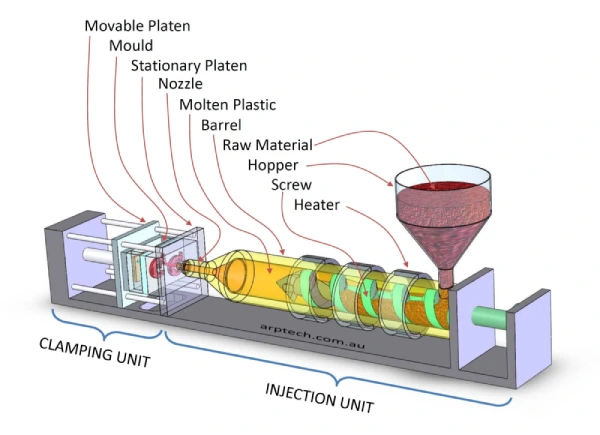
Injection molding shares similarities with extrusion molding, but the process differs in how the melted plastic is handled. In injection molding, the molten plastic is injected directly into a custom mold at high pressure to completely fill it and form a solid part. After injection, the plastic cools within the mold to maintain its new shape, and then the mold is opened to release the finished part.
This process can be likened to using a Jello mold: the mold is filled with liquid and then cooled to create the final product.
Common Uses for Injection Moulding
This method is widely used for producing large quantities of plastic parts, ranging from automotive components to surgical applications. It offers flexibility in creating products tailored to the specifications of designers and engineers.
In terms of cost, molds for injection molding can be expensive due to their requirement for high-strength materials like steel or aluminum, ensuring durability and precision. However, as with many manufacturing methods, the cost per unit decreases significantly with higher production volumes.
It's important to consider the timeline involved: tooling for injection molding can take up to 16 weeks to complete, while actual production typically spans around 4 weeks, depending on the complexity and volume of parts required.
5. Rotational Moulding
Also known as rotational molding or rotomolding, this method entails placing resin or liquid inside a mold and rotating it at high speeds. The rotation ensures that the liquid evenly coats the entire surface of the mold, resulting in a hollow part with uniformly thick walls. Once the mold is cooled and the liquid plastic solidifies into its new shape, the molded part is removed from the mold.
Rotational molding is highly efficient in terms of material usage, as very little material is wasted during the process. This efficiency makes it a cost-effective and environmentally friendly option for manufacturing plastic parts.
Common Uses for Rotational Moulding
This method is predominantly used for producing large, hollow parts such as car components, bins, kayaks, road cones, pet houses, and storage tanks.
Rotational molding relies on intricate molds that enable high customization and versatility in product design. These molds can incorporate special inserts, curves, logos, and slots to modify the final product as desired. Such flexibility allows for tailored manufacturing of a wide range of products to meet specific requirements and design preferences.
Tooling costs in rotational molding are typically lower compared to methods like injection molding and blow molding. This results in lower initial startup costs and more efficient production economics, even when producing at low volumes. This affordability and flexibility make rotational molding a viable option for manufacturing a diverse range of products economically.
If you are interested in our affordable injection molding products, please leave your contact information, Younger Mould will provide you with favorable quotations and meticulous plastic molding services.
What Is Tooling For Injection Molding?
5 Things You Need to Know About Plastic Injection Molding
Related Article

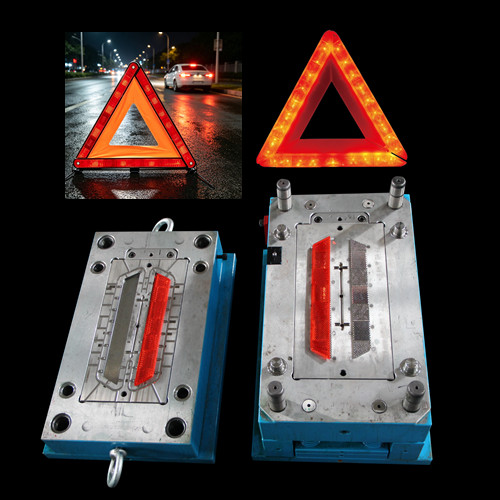
We are a professional mold manufacturer in Huangyan, China, specializing in high-precision injection molds for parking reflex reflectors and warning triangles. Our molds are made with durable steel for long service life, supporting custom designs and stable mass production to meet your automotive accessory manufacturing needs.
Parking reflex refletcor warning triangle mould