ls 3D Printing Better Than Injection Molding?
In the evolving landscape of manufacturing, two technologies stand out for their ability to produce high quality plastic parts: injection molding 3d printing. Each has its own strengths and limitations, making them suitable for different applications.
Before diving into the comparison, it's important to understand what each technology entails and how they function within a manufacturing workflow.
What Is 3D Printing?
3D printing , also known as additive manufacturing, builds parts layer by layer from digital models. It supports a wide range of materials, including thermoplastics like PLA, ABS, PETG, and even engineering grade resins and metals.
This method allows for rapid prototyping, complex geometries, and customization without the need for tooling, making it ideal for small-scale or one-off production.
What Is Injection Molding?
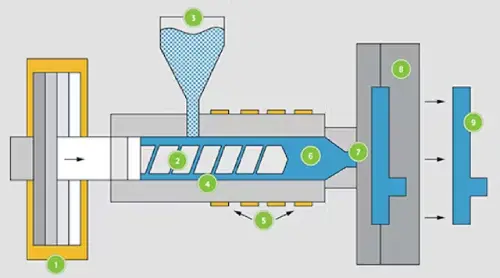
Injection molding is a subtractive manufacturing process where molten thermoplastic or thermoset material is injected under high pressure into a mold cavity. Once cooled, the part is ejected and ready for use.
This method is highly efficient for large-scale production and follows a structured set of injection molding process steps , which we will explore later in this article.
When Is 3D Printing Advantageous?
While 3D printing may not yet rival the speed and scalability of injection molding, it offers several advantages in specific scenarios:
1. Rapid Prototyping Without Tooling Costs
One of the biggest benefits of 3D printing is its ability to produce functional prototypes quickly and affordably — without requiring expensive mold tooling. This makes it ideal for early-stage product development, especially when exploring form, fit, and function.
For example, companies designing wearable devices or medical components can use 3D printing to test designs before committing to full-scale injection molding.
2. Complex Geometries and Customization
3D printing excels at creating parts with intricate internal structures, variable wall thicknesses, and overmolded features that would be difficult or impossible to achieve using traditional molds.
This level of complexity is particularly valuable in niche markets such as:
Custom prosthetics
Soft robotics
Wearable sensors
3. Low-Volume Production Feasibility
For startups or small businesses that don't require thousands of units, 3D printing provides a viable alternative to injection molding. It eliminates the need for large upfront investments in mold design and tooling, which are essential for injection molding design guide -based workflows.
The Strengths of Injection Molding
Despite the rise of advanced 3D printing technologies, injection molding remains the dominant method for high-volume production due to several key advantages:
1. Superior Speed and Scalability
Once the mold is created, injection molding can produce thousands — even millions — of identical parts in a short amount of time. Each cycle typically takes only seconds, enabling manufacturers to meet large-scale production demands efficiently.
This scalability makes injection molding ideal for industries such as automotive, where components like dashboard panels and lighting housings are produced in bulk.
2. Cost Efficiency at Scale
Although the initial costs for mold creation and setup are high, the per-unit cost drops significantly with increased production volume. For large orders, injection molding is often far more economical than any form of 3D printing — including multi-material or industrial-grade 3D printing.
3. Material Versatility and Performance
Injection molding supports a wide range of materials, including engineering plastics like ABS, PC, nylon, and TPE, many of which offer superior mechanical strength, thermal resistance, and chemical stability compared to current 3D printing materials.
Additionally, specialized resins can be formulated for biocompatibility, flame retardancy, or food-grade compliance — all of which are crucial in regulated industries.
Comparing 3D Printing vs. Injection Molding: Key Considerations
To determine whether 3D printing is better than injection molding , let's break down the decision-making process into several critical categories.
1. Design Flexibility and Complexity
3D printing wins in terms of design freedom. Since there's no need for a physical mold, designers can iterate rapidly and incorporate complex internal channels, lattice structures, and organic shapes that are challenging for traditional molds.
However, injection molding has evolved significantly, especially with tools like simulation software and advanced mold design techniques found in the injection molding design guide . These allow engineers to optimize part geometry and reduce defects, even in complex parts.
2. Production Volume and Cost Analysis
As previously mentioned, 3D printing is best suited for low-volume production, while injection molding shines in high-volume runs.
If your goal is to produce just a few dozen parts, 3D printing might be more cost-effective. But if you're looking to manufacture hundreds or thousands of parts, investing in a mold and following standard injection molding process steps becomes more economical.
3. Material Properties and Performance
Currently, 3D printing lags behind injection molding in terms of material performance. While some 3D-printed thermoplastics offer decent strength and durability, they generally do not match the consistency and mechanical properties of molded parts made from industrial-grade resins.
That said, ongoing advancements in additive manufacturing materials may close this gap in the near future.
4. Time to Market and Iteration Speed
For fast iteration cycles, 3D printing is unmatched. Design changes can be implemented almost instantly, allowing for rapid testing and refinement.
In contrast, modifying a mold for injection molding can take days or weeks and incur additional costs. However, once the mold is finalized, production proceeds quickly and consistently.
Can 3D Printing Be Used to Create Injection Molds?
An exciting development in the field of manufacturing is the use of 3D print injection mold technology. In some cases, 3D printing is being used to fabricate prototype molds or even low-volume production molds.
This hybrid approach combines the flexibility of 3D printing with the efficiency of injection molding and includes the following benefits:
Reduced mold development time
Lower tooling costs for prototype testing
Ability to test multiple mold iterations before finalizing the steel or aluminum version
However, these 3D printed molds are typically limited to low-volume or experimental use due to their lower thermal resistance and shorter lifespan compared to traditionally machined molds.
Real-World Applications and Industry Use Cases
To further illustrate when 3D printing or injection molding is the better choice, let's look at industry-specific examples.
Medical Device Development
In the medical device industry , where customization and biocompatibility are key, 3D printing is often used during the prototyping phase. However, once the design is finalized, injection molding is employed to mass-produce sterile, FDA-compliant components like syringes, surgical trays, and diagnostic housing.
Automotive Component Manufacturing
The automotive sector relies heavily on injection molding for producing durable, high-performance parts such as dashboards, seals, and lighting components. Mold design follows strict guidelines outlined in the injection molding design guide , ensuring dimensional accuracy and repeatability.
However, for concept cars or custom vehicle interiors, 3D printing can be used to create one-off parts or test new designs before moving to full-scale production.
Consumer Electronics and Wearables
In the electronics industry , both technologies play a role. 3D printing is used to develop soft-touch grips, wearable sensors, and ergonomic prototypes. Meanwhile, injection molding handles the mass production of casings, buttons, and connectors.
So, is 3D printing better than injection molding ? The answer depends entirely on your project requirements.
If you're in the prototyping stage , need complex geometries , or are producing small batches , 3D printing offers flexibility and reduced upfront costs.
If you're aiming for mass production , consistent quality, and cost-efficiency at scale , injection molding remains the gold standard.
Understanding the injection molding process steps , leveraging the injection molding design guide , and exploring innovative approaches like 3D print injection mold creation can help bridge the gap between these two powerful technologies.
Ultimately, the most successful manufacturing strategies combine the strengths of both — using 3D printing for early-stage development and injection molding for scalable, high-quality production.
Younger Mould is recognized as a leading global plastic injection moulding manufacturer, renowned for our superior quality, innovative engineering, and trusted industry reputation. With a steadfast commitment to excellence, we have established enduring partnerships with clients worldwide. If you're in need of high quality 3d print injection mold, we invite you to leave your contact information. Our dedicated team will offer you competitive pricing and tailored solutions to meet your unique requirements.
Why Is Injection Mold So Expensive?
Is Injection Molding Expensive?
Related Article