Is Injection Molding Cheaper Than 3d Printing?
As modern manufacturing continues to evolve, two technologies have risen to the forefront for producing plastic and composite components: injection molding and 3D printing. For designers, engineers, and procurement managers, one of the most frequently asked questions is: Is injection molding cheaper than 3D printing? Especially in the context of moulding car parts, understanding the cost structure, scalability, and material considerations of each method is crucial.
Introduction to the Two Methods: Injection Molding vs. 3D Printing
Before diving into cost analysis, let's briefly define the two manufacturing processes.
What Is Injection Molding?
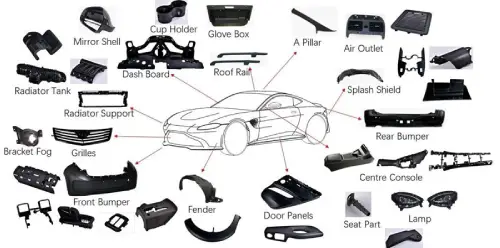
Injection molding is a traditional manufacturing process where molten material—typically thermoplastic or thermoset resin—is injected into a precision engineered mold to form parts. This process is widely used in injection molding car parts, including dashboards, bumpers, door panels, and light housings.
What Is 3D Printing?
3D printing, or additive manufacturing, builds parts layer by layer from digital files. It is commonly used for prototyping, low-volume runs, and complex geometry that may be difficult or impossible to achieve with traditional methods.
While both technologies serve different purposes, the overlap in certain industries—such as automotive tooling and prototyping—has sparked an ongoing debate: Is injection molding cheaper than 3D printing?
Cost Structure: Injection Molding vs 3D Printing
Tooling and Setup Costs
Injection molding requires the creation of a mold, usually made from hardened steel or aluminum. The cost of producing this mold can range from a few thousand to tens of thousands of dollars depending on complexity and tolerances.
3D printing, on the other hand, does not require tooling. The setup cost is essentially limited to slicing the model and loading it into the printer.
Verdict: For very low volumes (1–50 units), 3D printing is typically cheaper because it avoids high initial mold costs. However, as quantities increase, the cost-per-part in injection molding drops significantly.
Per Part Production Costs
In injection molding, once the mold is made, parts can be produced in seconds with extremely low per unit costs—often under $1 per part.
3D printing incurs high material costs and long print times per unit, which leads to higher per-part expenses, especially in large scale production.
Verdict: For production volumes over a few hundred units, injection molding is cheaper than 3D printing by a wide margin.
Speed and Production Scale in Moulding Car Parts
Production Speed
Injection molding car parts can produce thousands of identical units per day using multi-cavity molds and high tonnage machines.
3D printing is relatively slow; even high end industrial printers may take hours to produce a single part, depending on size and complexity.
Volume Efficiency
Injection molding becomes economically viable and scalable at high volumes—typically 1,000+ parts.
3D printing excels in single part or small batch production, especially for prototyping or customization.
Conclusion: For high volume manufacturing, especially in automotive, moulding car parts using injection molding is faster and more cost effective.
Material Considerations: Automotive Applications
Injection Molding Materials for Automotive
Common materials used in injection moulding automotive parts include:
ABS: Good impact strength, used in dashboards.
Polypropylene (PP): Lightweight and chemical resistant, common in bumpers.
Nylon (PA): High durability for under the hood components.
Polycarbonate (PC): Used in lighting components.
These materials are tested for:
Thermal resistance
UV stability
Flame retardance
Recyclability
Younger Mould works with these resins to produce high performance tooling for OEM and aftermarket automotive applications.
3D Printing Materials
While 3D printing can handle various materials (PLA, PETG, ABS, resin, nylon), many of these lack the strength, heat resistance, and surface finish required for injection molding car parts in real world vehicle environments.
Verdict: For parts that must meet strict automotive standards, injection molding materials outperform 3D printing options in most categories.
Surface Finish, Tolerances, and Assembly Fit
Injection Molding:
Delivers smooth surface finishes straight out of the mold.
Offers repeatable tight tolerances.
Allows for overmolding, inserts, and complex geometries in multi stage tooling.
3D Printing:
Surface finish may require post-processing (sanding, vapor smoothing).
Layer lines are visible on most prints.
Dimensional accuracy varies depending on printer calibration and material shrinkage.
In the automotive sector, where fit and finish matter (especially in interior trim and exterior components), injection molding remains the preferred choice for final production.
Design Flexibility and Iteration Cycles
When 3D Printing Has the Advantage:
Rapid prototyping for testing design concepts.
Design flexibility: Complex geometries with internal channels, lattice structures, and overhangs.
No tooling delays, allowing for faster design changes.
When Injection Molding Shines:
Predictability and consistency: Ideal for large-scale part deployment.
Multi part assemblies: Molded components can be engineered to snap or fasten together precisely.
Surface finish variety: From textured to high-gloss.
In practice, many manufacturers—including Younger Mould—use 3D printing during the prototyping phase and switch to injection molding for final production runs.
Environmental and Sustainability Factors
Injection molding typically generates less waste per part during high-volume production.
3D printing, while additive in nature, often involves support structures that must be discarded.
Energy consumption is higher per part for 3D printing compared to fully optimized injection molding machines.
Recyclability is also a concern. Injection molding resins like PP and ABS are often recyclable, whereas many 3D printed resins and composites are not.
Summary: Is Injection Molding Cheaper Than 3D Printing?
In the automotive industry, where mass production, safety, and durability are non-negotiable, injection molding is cheaper than 3D printing—especially for injection moulding automotive parts and long term component supply.
Companies like Younger Mould exemplify this balance, offering high-quality, precision-engineered tooling for automotive OEMs and Tier-1 suppliers while integrating digital tools for design verification and cost optimization.
While 3D printing continues to gain popularity for its flexibility and accessibility, it is not yet cost effective for large scale automotive production. For engineers and manufacturers evaluating long term part production—especially in the realm of moulding car parts—the answer is clear:
Injection molding is not only cheaper than 3D printing for mass production, but also more efficient, durable, and scalable.
By understanding the strengths and limitations of each technology, companies can better align their design and production strategies with their business goals.
Younger Mould is a reputable leader in China's injection moulding automotive parts industry, known globally for our dedication to quality, innovation, and reliability. We specialize in precision engineered moulding car parts and offer tailored solutions to meet diverse project requirements—always at competitive prices. Share your contact information, and our team will promptly connect with you to discuss your specific needs.
What Are The Three Types of Rapid Prototyping?
What Is A Car Mould?
Related Article