Is Your Front Light BMC Mold Built for Mass Production?
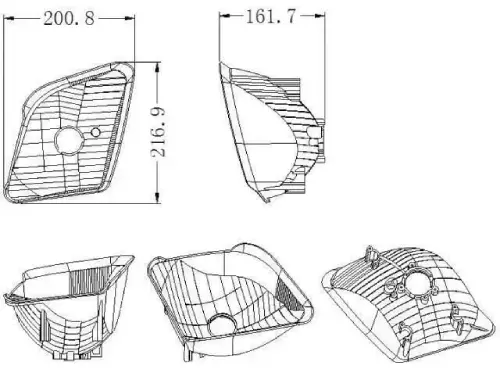
In today's automotive industry, lighting components are no longer just functional—they're integral to a vehicle's brand identity, aerodynamics, and energy efficiency. As demand for precision optics and durable housings rises, Bulk Molding Compound (BMC) has become a go-to material for producing complex, heat-resistant lighting parts. Among these, the front light BMC mold stands at the center of precision tooling innovation.
What Is a Front Light BMC Mold?
A front light BMC mold is a specialized compression or injection compression mold used to shape composite materials—specifically bulk molding compounds—into optical-grade or structural lighting parts such as:
Headlight reflectors
Inner bezels
Lamp housings
Heat resistant structural elements
BMC, composed of thermoset resin, fillers, fiberglass, and additives, provides excellent mechanical strength, dimensional stability, and thermal resistance—making it ideal for high-heat zones like headlamps.
These molds must achieve extremely high surface precision, optical clarity, and tight dimensional tolerances. Younger Mould specializes in optical polishing, steel selection, and thermal management systems that ensure successful mass production.
Key Components Molded with Reflector BMC Mold
Reflector BMC molds are tailored to produce mirror-finish or textured internal components that direct light beams efficiently and consistently. These reflectors demand:
High temperature stability (up to 150–180°C for halogen or LED systems)
Reflective geometry precision, typically requiring mold polishing to SPI A2 or better
Low warpage and shrinkage, critical for maintaining light path accuracy
UV resistance, ensuring long service life without degradation
Unlike thermoplastics, BMC doesn't warp easily under heat, making it suitable for tight-fitting components in complex optical assemblies. Younger Mould employs EDM, mirror polishing, and custom venting in their reflector mold designs to maintain form and optical clarity.
Differences Between Thermoplastic and BMC Molds for Headlamp Parts
Understanding the manufacturing process is crucial to selecting the right tooling. Here's how automotive BMC molds compare to traditional thermoplastic molds:
Feature Thermoplastic Injection Molding BMC Molding (Compression/Injection-Compression)
Material PC, ABS, PMMA Glass-filled polyester resin (BMC)
Temperature Resistance Up to 120°C Up to 180°C or more
Cycle Time Fast Slightly slower
Surface Finish Good with post processing Excellent for reflectors (with polishing)
Application Lenses, housings Reflectors, heat-resistant parts
Thermoplastics are often chosen for external lenses or transparent parts, while BMC is ideal for automotive reflectors and front light bases where heat and optical reflection matter.
Is Your Automotive BMC Mold Optimized for Mass Production?
To qualify for mass production, an automotive BMC mold must go beyond basic function. Key traits of an optimized mold include:
Precision guided parting surfaces to prevent flashing
Balanced temperature control using cartridge or oil heating systems
Vented cavities to allow for gas release during curing
Multi cavity design to increase output
Automatic demolding systems such as hydraulic ejectors or stripper plates
Younger Mould implements all of the above features using simulation tools and CNC precision machining to produce tooling ready for 500K+ production runs with minimal maintenance downtime.
Surface Finishing and Optical Requirements in Reflector Molds
In reflector BMC mold, the surface finish directly impacts how light is distributed. Depending on the lighting design (e.g., flood vs. spot), surface textures may include:
Mirror finish polishing: For precise beam control (high beam reflectors)
Matte or semi-gloss textures: For diffuse light or aesthetic styling
Laser etched patterns: For enhanced beam diffusion or branding elements
Achieving these finishes requires precision polishing, often to Ra 0.05 μm or better. Younger Mould utilizes high-hardness tool steel (e.g., S136, H13) and hand-finishing to meet OEM lighting standards.
Tooling Materials Used in Automotive BMC Molds
Because BMC is abrasive and operates at high temperatures, material selection is critical:
S136 or H13 steel: Common for reflector cavities due to polishability and hardness
420SS: Offers corrosion resistance and mirror polishing capabilities
Beryllium copper inserts: For high-efficiency heat transfer and hot spots
The team at Younger Mould frequently evaluates tool steel fatigue resistance, surface treatment compatibility (e.g., nitriding or chrome plating), and thermal conductivity before mold manufacturing begins.
Common Defects in Front Light BMC Molded Parts—and How to Prevent Them
Despite its strengths, BMC can be challenging to mold. Common defects include:
Blistering or porosity: Caused by poor venting or excessive temperature
Surface waviness: Due to uneven curing or material flow
Delamination: From contamination or improper preform placement
Flash: From poor parting line fit or low clamp force
Solutions include controlled pre-heating, vacuum-assisted molding, and optimized curing cycles. Younger Mould's tooling designs often include closed-loop temperature feedback and dedicated vent lines to address these quality concerns from the outset.
The Role of Injection Blow Molding Products in Automotive Lighting
While BMC is excellent for structural and reflective parts, injection blow molding products are often used for:
Lamp lens domes
Fluid reservoirs near lighting systems
Transparent or translucent housing covers
Injection blow molding offers:
Seamless hollow geometries
Excellent optical clarity (for PC or PET materials)
High speed production capabilities
These products complement BMC-based reflectors and structures. Choosing between the two depends on function: heat resistance vs. light transmission. Younger Mould supports both tooling approaches, ensuring part compatibility during system integration.
Why Simulation and Prototyping Are Essential in BMC Mold Development
Given the costs and time associated with automotive tooling, simulation is now a standard. Benefits of early-stage simulation include:
Mold flow analysis: Predicts material fill, curing, and venting issues
Thermal mapping: Prevents hot spots and uneven curing
Deformation and shrinkage prediction: Avoids post-cure warpage
Optical beam validation: For reflector geometry via ray-tracing
Younger Mould uses Moldex3D, UG NX, and 3D scanning to test designs virtually before committing to steel—greatly reducing iteration time.
Trends in Future Automotive BMC Mold Applications
BMC tooling continues to evolve alongside automotive trends. Key innovations include:
Lightweight, thin wall BMC designs for EV platforms
Integrated mounting bosses and inserts for modular assembly
BMC compatible sensor mounts (LiDAR, radar reflectors)
Improved recyclability and environmental resistance
As automotive lighting becomes smarter, the tools behind them must keep pace. Younger Mould is actively exploring hybrid tooling concepts, multi-material molding, and enhanced reflector geometries to support next-gen lighting modules.
If your current production line faces delays, part inconsistencies, or high defect rates in your headlamp or reflector assemblies, the root cause might be your front light BMC mold. Today's market demands tooling that is not only precise but also durable, repeatable, and fast.
Whether you're manufacturing reflector BMC mold components, producing injection blow molding products, or investing in a complete automotive BMC mold package, choosing the right tooling partner is key. High-precision firms like Younger Mould offer a deep understanding of materials, simulation, and finishing that aligns with mass production expectations—while maintaining the flexibility to support future innovations.
Your tooling defines your production. So, is your front light BMC mold truly built for mass production?
Younger Mould manufactures injection blow molding products, widely acknowledged for our exceptional quality, innovative solutions, and trusted reputation in the industry. Committed to excellence, we have built long standing relationships with clients across the globe. If you're seeking high quality automotive bmc mold, please feel free to leave your contact details. Our dedicated team will provide you with competitive pricing and customized service to meet your specific needs.
Automobile head lamp mold supplier in China
Are You Using the Right Motorcycle Plastic Mould?
Related Article