Advanced Engineering Principles in Bi-Color Taillight Mold Manufacturing
2026-02-28
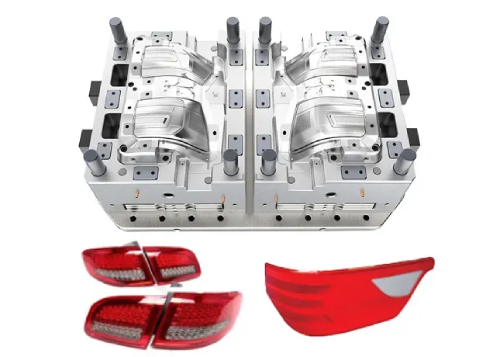
The automotive lighting industry has evolved significantly as vehicle manufacturers demand increasingly sophisticated taillight systems combining functional safety requirements with distinctive brand identity elements. At the manufacturing core of these advanced lighting components lies the bi-color taillight mold—a highly specialized tooling solution requiring precision engineering, advanced injection molding technology, and rigorous quality control protocols. B2B procurement professionals, automotive lighting manufacturers, and tier-one suppliers evaluating double color taillight mold capabilities face complex technical decisions extending far beyond basic tooling specifications.
Bi-Color Injection Molding Fundamentals
Sequential injection molding principles enable dual material integration—first shot material solidifies partially before second shot injection, creating strong molecular bonding at interface zones while maintaining distinct material properties in each section.
Rotational mold systems facilitate bi-color production—mold halves rotate 180 degrees between injection cycles allowing precise alignment of first and second shot cavities with positional accuracy maintained within ±0.02mm tolerance.
Material compatibility considerations prove critical for interface bonding—thermoplastic combinations must exhibit compatible melt temperatures and chemical affinity to ensure strong adhesion without delamination under thermal cycling conditions.
Gate design strategies influence weld line formation and aesthetic quality—strategic gate placement minimizes visible witness marks while ensuring complete cavity filling for both material shots without air entrapment.
Cooling system optimization balances cycle efficiency with part quality—independent temperature control zones for each cavity section enable precise thermal management preventing premature solidification or excessive cycle times.
Ejection system design requires careful consideration for bi-color components—multi-point ejector arrangements prevent marking on critical optical surfaces while ensuring reliable release without deformation of delicate lens features.
Mold steel selection balances wear resistance with thermal conductivity—typically utilizing P20 pre-hardened steel for standard applications or H13 tool steel for high-volume production requiring extended service life under thermal cycling conditions.
Surface finish specifications ensure optical clarity and aesthetic quality—critical lens surfaces require diamond polished cavities achieving surface roughness below 0.01 microns Ra for optimal light transmission characteristics.
Optical Design Integration
Bi-color taillight mold manufacturing requires sophisticated optical engineering capabilities to achieve precise light distribution patterns while maintaining aesthetic design requirements.
Total internal reflection (TIR) lens design principles optimize light extraction—precise prism geometries and surface textures direct light output according to regulatory requirements while minimizing internal reflection losses.
Light guide technology integration enables uniform illumination—complex channel geometries distribute LED light sources across large surface areas creating consistent brightness levels without hot spots or dark zones.
Fresnel lens elements enhance optical efficiency—concentric ring patterns focus and direct light output achieving specific beam patterns required for brake light, turn signal, and tail light functions.
Surface texture specifications influence light diffusion characteristics—matte finishes ranging from 0.8 to 3.2 microns Ra provide controlled light scattering while maintaining clarity for regulatory compliance testing.
Parting line precision ensures optical performance—critical lens edges require flash-free parting lines maintained within ±0.01mm tolerance to prevent light leakage and maintain beam pattern integrity.
Draft angle optimization balances ejection requirements with optical performance—typically ranging from 1° to 3° depending on lens geometry and material shrinkage characteristics while maintaining optical surface integrity.
Wall thickness uniformity prevents optical distortion—variations exceeding 10% of nominal thickness create visible sink marks and light refraction anomalies compromising aesthetic and functional performance.
UV resistance requirements ensure long term optical clarity—lens materials must maintain light transmission properties exceeding 85% after 3,000 hours of accelerated weathering testing without yellowing or haze formation.
Regulatory compliance testing validates optical performance—beam pattern measurements, color accuracy verification, and intensity testing ensure compliance with DOT, ECE, and SAE standards for automotive lighting applications.
Design for manufacturing principles optimize double color taillight mold complexity—collaborative engineering between optical designers and mold manufacturers reduces tooling costs while maintaining performance requirements through intelligent geometry simplification.
Material Science Considerations
Bi-color taillight mold manufacturing demands careful material selection balancing optical properties, weatherability, and processing characteristics for diverse component requirements.
Polycarbonate (PC) materials dominate lens applications—offering exceptional optical clarity exceeding 90% light transmission, superior impact resistance, and excellent heat resistance for high-intensity LED applications.
PMMA (acrylic) alternatives provide cost effective solutions—delivering good optical properties and weatherability while requiring lower processing temperatures and reduced tooling wear compared to polycarbonate.
Color masterbatch integration requires precise formulation—pigment concentrations typically ranging from 1-3% ensure consistent color matching across production batches while maintaining optical transmission requirements.
UV stabilizer additives protect against solar degradation—HALS (Hindered Amine Light Stabilizers) and UV absorbers prevent yellowing and embrittlement during extended outdoor exposure maintaining aesthetic appearance.
Flame retardancy requirements vary by component location—materials requiring UL94 V-2 or V-0 ratings ensure compliance with vehicle fire safety standards while maintaining optical clarity and surface finish quality.
Material flow characteristics influence mold design decisions—melt flow index (MFI) values between 8-15 g/10min typically provide optimal balance between cavity filling capability and dimensional stability for complex lens geometries.
Shrinkage rate considerations require precise mold compensation—thermoplastic materials exhibit shrinkage rates between 0.5-0.7% depending on material grade and processing conditions, requiring accurate mold cavity sizing to achieve final part dimensions.
Recycled content integration supports sustainability initiatives—many manufacturers now incorporate post-industrial recycled materials up to 20% content while maintaining optical properties through careful material blending and testing protocols.
Strategic Supplier Evaluation Frameworks for Tail Light Mold Supplier Selection
Optimal bi-color taillight mold procurement requires systematic evaluation extending beyond initial quotation comparisons to encompass technical capabilities, quality systems, and long-term partnership potential.
Technical capability assessment should include optical engineering expertise—suppliers maintaining dedicated lighting engineering teams with optical simulation software capabilities demonstrate deeper understanding of taillight performance requirements versus general mold manufacturers.
Manufacturing infrastructure verification proves essential—suppliers possessing CNC machining centers with 5-axis capabilities, precision grinding equipment, and coordinate measuring machines ensure dimensional accuracy required for optical applications.
Quality management system certification requires verification beyond documentation—auditing actual implementation of IATF 16949 procedures on production floor reveals genuine quality culture versus certificate-only compliance.
Material expertise influences final part quality—suppliers such as Younger Mould with established relationships with major thermoplastic compound manufacturers including Covestro, SABIC, and Mitsubishi Chemical demonstrate material processing knowledge essential for consistent results.
Prototype development capabilities accelerate time-to-market—suppliers capable of delivering functional prototypes within 4-5 weeks demonstrate robust design validation processes versus those requiring multiple iterations extending beyond 10 weeks.
Production capacity scalability matters for volume programs—suppliers capable of 20+ bi-color mold deliveries annually with flexible scheduling accommodate automotive industry ramp-up requirements without compromising quality standards.
Technical documentation quality reflects engineering rigor—comprehensive mold design documentation including mold flow analysis reports, thermal simulation results, and optical performance validation demonstrates supplier expertise and transparency.
After sales technical support infrastructure reduces program risk—suppliers providing mold maintenance services, spare parts inventory, and technical troubleshooting capabilities demonstrate long-term partnership commitment essential for production continuity.
Frequently Asked Questions
What distinguishes bi-color taillight mold technology from standard single-shot injection molding?
Bi-color taillight mold systems require rotational mechanisms, precise alignment systems, and independent temperature control zones enabling sequential injection of two materials with strong interfacial bonding while maintaining distinct optical and aesthetic properties in each section.
How does gate location selection impact bi-color taillight component optical performance?
Gate placement influences weld line formation, surface finish quality, and light transmission characteristics—optimal gate locations minimize visible witness marks on critical optical surfaces while ensuring complete cavity filling without air entrapment or flow hesitation that could compromise optical clarity.
What surface finish requirements ensure optimal optical performance in bi-color taillight lenses?
Critical optical surfaces require diamond-polished mold cavities achieving surface roughness below 0.01 microns Ra—this precision ensures maximum light transmission exceeding 90%, minimizes internal reflection losses, and provides excellent replication of optical prism geometries.
Why do specialized tail light mold supplier manufacturers offer competitive advantages for bi-color applications?
Established automotive lighting mold manufacturers combine optical engineering expertise with advanced bi-color molding capabilities while maintaining quality standards required for regulatory compliance—suppliers with dedicated lighting divisions demonstrate specialized knowledge in optical performance validation and aesthetic finish requirements.
How frequently should bi-color taillight molds undergo maintenance and refurbishment?
Preventive maintenance every 20,000 cycles including surface inspection, cooling system cleaning, and rotational mechanism lubrication extends double color taillight mold life significantly—major refurbishment including re-polishing and component replacement typically required after 150,000-250,000 cycles depending on production conditions and material abrasiveness.
Do You Know Thick Wall Projector Lens Mold?
How to Choose Automotive Tail Light Mold for OEM Engineers?
Related Article

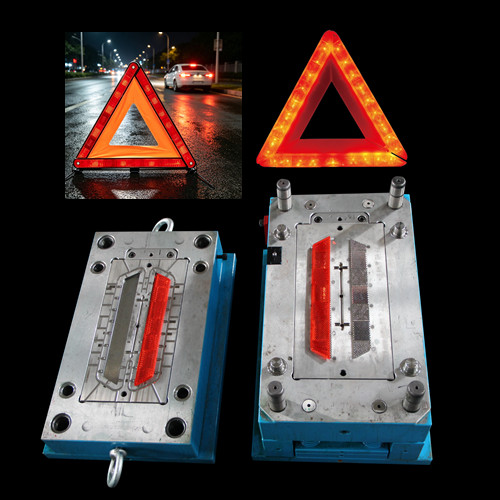
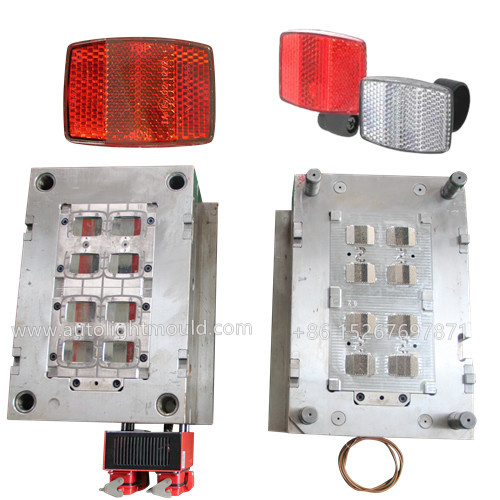
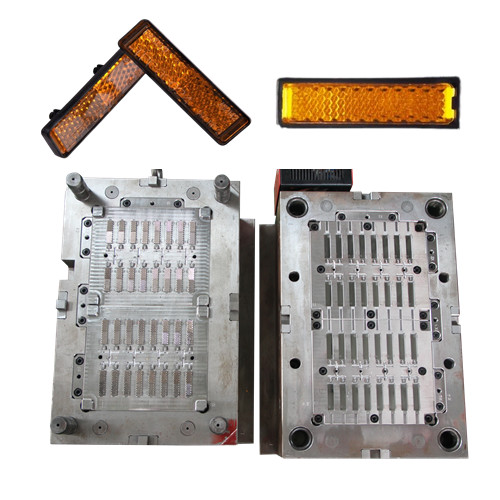
We are a professional mold manufacturer in Huangyan, China, specializing in high-precision injection molds for parking reflex reflectors and warning triangles. Our molds are made with durable steel for long service life, supporting custom designs and stable mass production to meet your automotive accessory manufacturing needs.
Parking reflex refletcor warning triangle mould