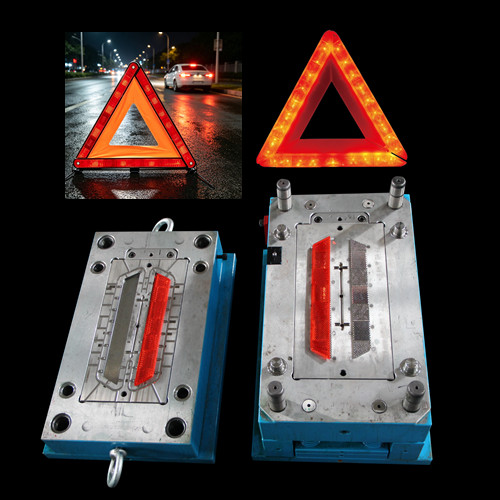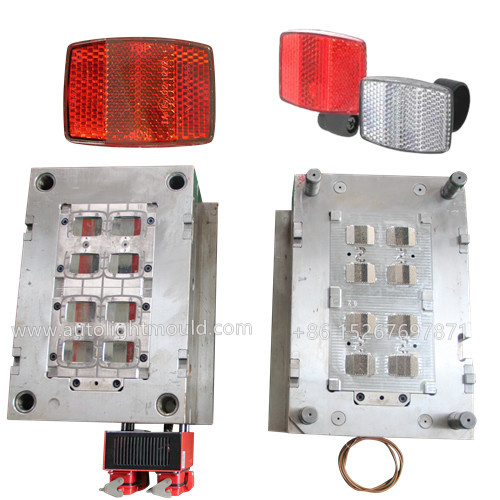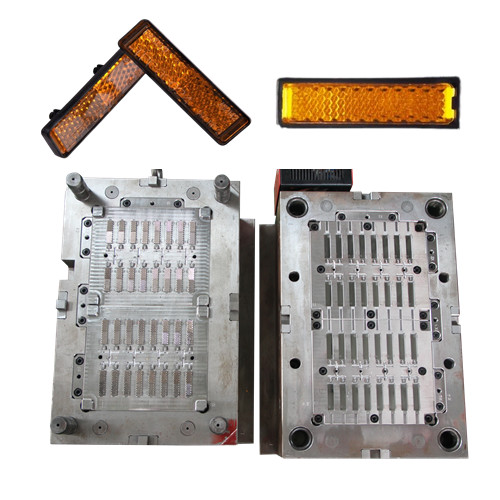
The Engineering Behind Mold for Motorcycle Rear Lamp
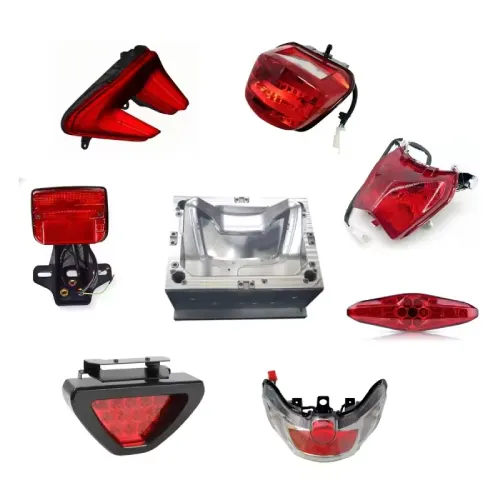
In the design and manufacturing of modern motorcycles, lighting systems play a crucial role in both safety and aesthetics. While headlights often receive the most attention, the mold for motorcycle rear lamp is equally vital—responsible for producing the tail lights, brake lights, and turn signals that communicate a rider's intentions to others on the road. These components must be durable, optically precise, and seamlessly integrated into the bike's overall design.
Understanding the Function and Structure of Mold for Motorcycle Rear Lamp
A mold for motorcycle rear lamp is a specialized injection mold used to produce the outer lens, internal reflector housing, and sometimes integrated mounting frames for rear lighting assemblies. Unlike simple plastic parts, these components must meet strict requirements for optical clarity, impact resistance, thermal stability, and weather resistance.
Most motorcycle rear lamps are made from polycarbonate (PC) or PMMA (acrylic), materials chosen for their transparency, UV resistance, and ability to withstand vibration and temperature fluctuations. The mold must replicate complex surface textures—such as prismatic patterns, diffusing ridges, or segmented lens zones—that control how light is emitted and perceived.
These molds are typically two-plate or three-plate systems made from hardened steel alloys like NAK80, P20HH, or 718H, selected for their excellent polishability and dimensional stability. The cavity surface is often finished to a high-gloss or textured SPI-A1 standard to ensure optical quality and aesthetic consistency across production batches.
One of the key challenges in designing a mold for motorcycle rear light is achieving uniform wall thickness. Variations can lead to warping, sink marks, or internal stress—especially critical in thin, curved lens designs. Additionally, the mold must support precise gate placement to avoid visible flow lines on the finished part.
Younger Mould applies advanced simulation tools and mold flow analysis to optimize filling, cooling, and ejection processes, ensuring that each mold for motorcycle tail light delivers consistent, high-quality output suitable for both OEM and aftermarket applications.
Design Considerations for Mold for Motorcycle Rear Lamp: Balancing Aesthetics and Performance
Modern motorcycle design emphasizes clean lines, aggressive styling, and brand-specific lighting signatures. This means the mold for motorcycle rear lamp must not only be functional but also support complex 3D geometries that conform to the bike's bodywork.
Key design factors include:
Contour matching – The lens must align perfectly with the fender, seat cowl, or subframe.
Multi-cavity or family mold configurations – To produce left and right units or integrate multiple components (e.g., lens and diffuser) in a single cycle.
Venting and gas trap management – Poor venting can cause burns or incomplete filling, especially in deep or narrow cavities.
Ejection system design – Lenses are fragile; improper ejection can lead to cracking or deformation.
Additionally, many modern rear lamps use LED technology, which generates less heat than halogen bulbs but requires precise optical alignment. This often involves multi-layer designs where a primary lens, secondary diffuser, and reflector housing are molded separately and then assembled.
Some advanced systems even use overmolding or insert molding, where a soft-touch rubber seal or metal bracket is embedded during the injection process. This reduces assembly time and improves sealing against moisture and dust—critical for motorcycles exposed to rain, mud, and road spray.
For example, a dual-function tail/brake light may require different color zones (red and brighter red) within the same lens. The mold for motorcycle rear lamp must support multi-shot molding or secondary coating processes to achieve this effect without compromising clarity.
Younger Mould addresses these complexities through 3D modeling and iterative prototyping, ensuring that each mold meets both functional and aesthetic requirements before full-scale production begins.
Material Selection and Surface Finishing for High-Optical-Clarity Molds
The performance of a mold for motorcycle tail light is directly influenced by the materials used in both the mold and the final part. Optical-grade polycarbonate is the most common choice for lenses due to its impact resistance and clarity. However, it is prone to UV degradation and scratching if not properly treated.
To protect against yellowing and surface wear, many manufacturers apply hard coatings or UV inhibitors post-molding. This means the mold for motorcycle rear light must produce a defect-free surface to ensure uniform coating adhesion. Any imperfection—such as a scratch, pin mark, or inconsistent polish—will be magnified when light passes through the lens.
Surface finishing is therefore critical. Most high-end molds require a mirror-like SPI-A1 finish, achieved through sequential diamond paste polishing or electropolishing. In some cases, chrome plating or PVD coating is applied to the mold cavity to enhance release properties and reduce maintenance.
Mold steels like NAK80 are favored for their ability to hold a fine polish and resist thermal fatigue over tens of thousands of cycles. For larger or more complex molds, pre-hardened steels like 718H offer a balance of toughness and machinability.
Younger Mould integrates these material and finishing standards into every project, ensuring that each mold for motorcycle rear lamp meets international quality benchmarks such as ISO 9001 and automotive-specific IATF 16949.
Quality Assurance and Long-Term Mold Performance in Production
Once a mold for motorcycle rear light is deployed, its reliability over time becomes a key factor in production efficiency and part consistency. Even minor issues—such as worn ejector pins, clogged cooling channels, or misaligned cores—can lead to defective parts, increased scrap rates, or unplanned downtime.
Automotive and motorcycle manufacturers rely on rigorous quality control measures, including:
In-line vision inspection systems – To detect surface defects or dimensional deviations.
Coordinate Measuring Machines (CMM) – For precise verification of lens geometry.
Mold monitoring sensors – To track pressure, temperature, and cycle times in real time.
Preventive maintenance is essential. Regular cleaning, lubrication, and inspection help extend the life of the mold and maintain part quality over long production runs. Some molds are designed with modular inserts, allowing for quick replacement of high-wear sections without scrapping the entire tool.
Younger Mould emphasizes durability and serviceability in its designs, incorporating standardized components, accessible cooling lines, and wear-resistant coatings—supporting long-term reliability in high-volume or custom production environments.
The Precision Behind Every Mold for Motorcycle Rear Lamp
The mold for motorcycle rear lamp is far more than a shaping tool—it's a precision instrument that ensures safety, enhances design, and supports mass production. Whether referred to as a mold for motorcycle rear light or mold for motorcycle tail light, these systems represent the intersection of optical engineering, material science, and advanced manufacturing.
As motorcycles adopt smarter, more dynamic lighting technologies—such as sequential turn signals or connected lighting systems—the demand for high-precision, complex molds will only increase. Companies like Younger Mould play a vital role in this evolution by applying technical expertise, simulation-driven design, and quality-focused engineering to every project.
By focusing on performance, consistency, and innovation, they help shape the future of motorcycle lighting—one high-quality mold at a time.
Younger Mould is a trusted name in China's mold for motorcycle rear lamp sector, recognized worldwide for our commitment to quality, innovation, and consistent reliability. As an industry leader, we specialize in delivering precision engineered mold for motorcycle rear light services, supporting clients with customized solutions designed to meet a wide range of project specifications—without compromising on speed or accuracy.
We pride ourselves on combining advanced manufacturing technologies with cost effective processes to offer high performance results at competitive rates. If you're looking for efficient mold for motorcycle tail light solutions, simply share your contact details with us. Our expert team will reach out promptly to discuss your project requirements and help bring your ideas to life.
Automotive head light mold manufacturer in China
Automotive fir tree cable tie mold manufacturer in China
Related Article