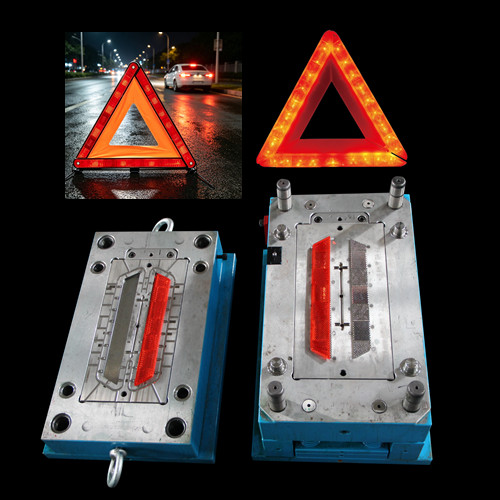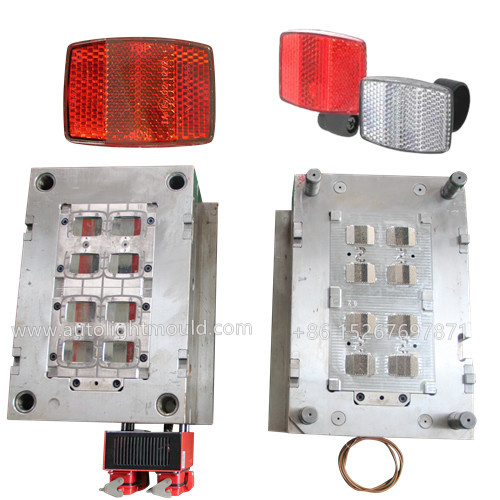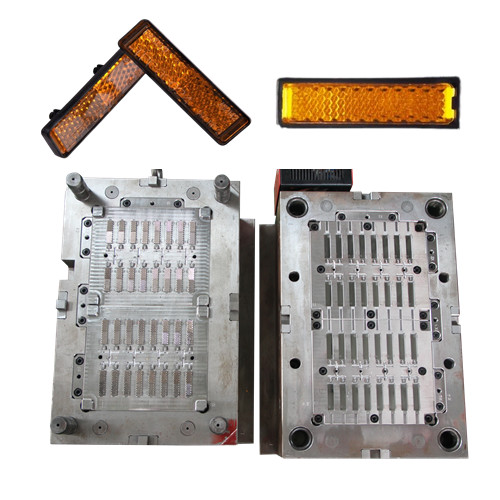
What Does an Optical Lens Mould Look Like?
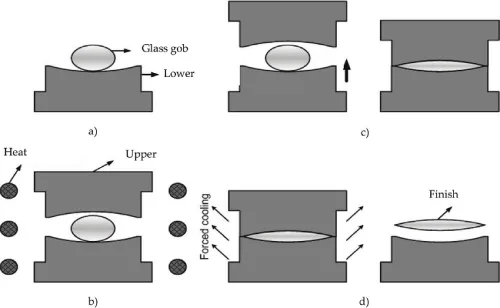
When engineers, product developers, or industrial designers search “What does optical lens mould look like?”, they are rarely looking for a superficial visual. Instead, they seek to understand how a seemingly inert block of steel can consistently produce plastic components that must meet stringent optical performance criteria—transmitting light with minimal distortion, maintaining precise focal points, and enduring thermal and mechanical stress over years of use. The answer lies not in aesthetics, but in the convergence of ultra precision machining, material science, thermal dynamics, and optical physics.
Deconstructing the Physical and Functional Architecture of an Optical Lens Mould
At first glance, an optical lens mould may resemble a conventional injection mold: a two-plate or three-plate steel assembly with cavities, runners, cooling lines, and ejection mechanisms. However, its true sophistication is revealed under magnification and through performance metrics. Unlike molds for structural or aesthetic parts, optical molds must replicate surface geometries with sub-micron accuracy—often featuring aspheric, toroidal, or freeform surfaces that cannot tolerate even minor deviations.
The core and cavity inserts are typically machined from corrosion resistant, high polish tool steels such as S136 (stainless) or NAK80, selected for their dimensional stability and ability to achieve mirror finishes. Surface roughness is held to Ra ≤ 0.01 µm—a level comparable to optical glass grinding—ensuring that no micro-imperfections transfer to the molded lens. This polish is not cosmetic; it directly affects light transmission, scatter, and haze.
Equally critical is thermal management. Thick wall lenses—common in automotive projector headlights or motorcycle front lights—require conformal cooling channels that follow the contour of the lens geometry. Traditional straight-drilled cooling lines create thermal gradients, leading to uneven shrinkage, internal stress, and birefringence (a change in refractive index due to molecular orientation). Advanced molds now integrate additively manufactured cooling circuits or baffle systems to maintain uniform mold temperature, reducing cycle time while preserving optical clarity.
Gate design is another defining feature. Optical lenses often use film gates, tunnel gates, or hot runner pinpoint gates positioned outside the functional optical zone to avoid flow lines or weld marks in critical light paths. In multi-cavity molds, runner balancing is validated through mold flow simulation with optical-specific parameters—such as shear-induced birefringence and frozen-in orientation—to ensure part-to-part consistency.
Why Conventional Injection Molding Fails for High Performance Molded Optics
Producing moulded optics is fundamentally different from standard plastic injection. The goal isn’t just dimensional accuracy—it’s optical fidelity. Even minor process variations can introduce defects invisible to the naked eye but catastrophic for performance:
Residual stress alters the refractive index, causing beam distortion in projector systems.
Micro-voids or sink marks in thick sections scatter light, reducing luminous efficacy.
Surface haze from poor venting or contamination degrades contrast in imaging or sensing applications.
To mitigate these risks, the entire injection mould for optical parts ecosystem must be controlled: from material drying (optical-grade PC or COC must be dried to <50 ppm moisture) to cleanroom molding environments (ISO Class 7 or better for medical or consumer electronics). Process parameters—melt temperature, injection speed, packing pressure, and cooling time—are tightly monitored and often locked via scientific molding protocols.
Moreover, post-molding validation is essential. Leading manufacturers don’t just inspect dimensions; they measure total luminous transmittance, haze percentage, wavefront error, and MTF (Modulation Transfer Function) using interferometers and goniophotometers. This closed-loop feedback informs mold refinements and ensures the tool meets both mechanical and optical specifications.
The Strategic Emergence of China Optical Lens Mould Expertise
While Germany, Japan, and the U.S. long dominated high-end optical molding, a new wave of specialized Chinese toolmakers has risen to meet global demand—particularly in automotive, motorcycle, and consumer electronics sectors. The term china optical lens mould now signifies not just geographic origin, but a growing cluster of vertically integrated, technically adept suppliers capable of competing on precision, not just price.
What sets top-tier Chinese optical lens mould suppliers apart is their focus on niche applications. For instance, in the motorcycle and automotive lighting segment, thick-wall transparent lenses—used in projector headlights or LED daytime running lights—pose unique challenges. These parts can be 6–12mm thick, requiring extended cooling times and precise packing profiles to avoid sink marks or internal voids.
Companies like Younger Mould exemplify this specialization. As noted on their technical page, they operate a dedicated facility for thick wall lens mold and transparent parts, offering end-to-end services from optical mold design to mass production. Their portfolio includes two-color and three-color molds for integrated headlight/taillight assemblies, LED light guide strip molds, and projector lens molds—all requiring micron-level alignment between optical and structural components.
Critically, their approach is application-driven. Rather than treating the mold as a standalone tool, they consider the entire optical system: how the lens interacts with LEDs, reflectors, and housing seals. This systems-level thinking enables them to function not just as a vendor, but as a collaborative optical lens mould supplier embedded in the product development cycle.
How to Evaluate and Select a Qualified Optical Lens Mould Supplier
Given the technical stakes, selecting an optical lens mould supplier requires more than RFQ comparisons. Key evaluation criteria include:
Metrology Capabilities: Can they provide 3D surface profilometry, form error maps, and surface roughness certificates?
Optical Validation Infrastructure: Do they possess in-house equipment to test transmission, haze, and beam pattern?
Material & Process Expertise: Are they experienced with optical-grade resins (e.g., Makrolon GP, Zeonex, or Lexan EXL)?
Cleanroom Molding: Essential for lenses used in cameras, LiDAR, or medical devices.
Design for Manufacturability (DFM) Input: The best suppliers engage early to optimize wall transitions, gate locations, and draft angles without compromising optical zones.
Additionally, look for evidence of complex project execution—such as multi-shot molds combining clear PC with black ABS for aesthetic bezels, or micro-structured surfaces for light diffusion. These capabilities signal deep process mastery.
The Future of Optical Moulding: Integration, Miniaturization, and Sustainability
As vehicles become smarter and wearables more pervasive, moulded optics are evolving toward greater integration. Headlights now incorporate adaptive driving beams (ADB), requiring arrays of micro lenses molded with extreme positional accuracy. AR glasses demand ultra-thin, lightweight optics with anti-reflective microstructures—pushing mold makers toward nano-imprint and UV-curing hybrid processes.
Sustainability is also reshaping the field. Bio-based polycarbonates and recyclable COC resins are gaining traction, but they behave differently during molding—requiring updated thermal profiles and venting strategies. Forward-looking optical lens mould suppliers are already adapting their tooling to accommodate these next-generation materials.
So, what does an optical lens mould truly look like? Externally, it may appear as a polished steel block. But internally, it represents decades of accumulated knowledge in light physics, polymer rheology, and precision engineering. In an era where light is data, safety, and identity—whether on a motorcycle, in a smartphone, or inside a surgical robot—the optical lens mould is the silent enabler of innovation.
Younger Mould is a leading China optical lens mould supplier specializing in high quality moulded optics solutions. With a reputation built on innovation, precision, and reliability, we provide customized optical moulding services that meet the specific needs of global clients. Our engineering team ensures every injection mould for optical parts is designed with advanced technology, delivering consistent performance, fast turnaround, and exceptional accuracy—helping manufacturers achieve efficiency without compromising on quality.
Auto tail lamp mold manufactory in China---Professional plastic mold maker
Is a Mold for Motorcycle Front Light Easy to Make?
Related Article