Why Add Salt And Soda To Molten Aluminum?
2025-12-19
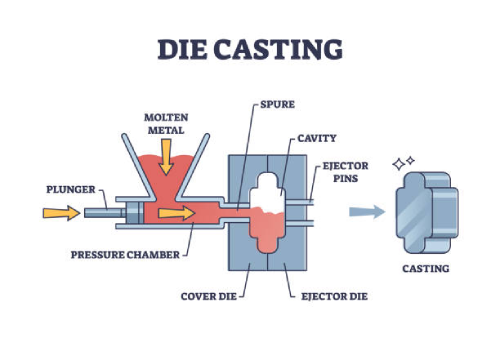
Why add salt and soda to molten aluminum? This seemingly simple question opens the door to a sophisticated metallurgical practice known as fluxing—a critical step in maintaining melt purity, ensuring casting integrity, and achieving consistent mechanical properties in final components. While industrial grade alloys like A380 dominate high pressure die casting (HPDC) applications—especially in automotive lighting housings—how the melt is prepared before injection profoundly affects mold life, surface finish, and defect rates.
The Role of Salt and Soda in Molten Aluminum: Fluxing for Oxide and Impurity Removal
Salt (typically NaCl) and soda ash (Na₂CO₃) are combined to form a chloride based flux used during the melting and holding stages of aluminum processing. Contrary to popular belief, these additives don't “alloy” with aluminum; instead, they act as reactive agents that facilitate the removal of oxides, hydrogen, and metallic impurities like magnesium, lithium, or zinc.
When aluminum melts (at ~660°C), it rapidly forms a tough Al₂O₃ oxide layer on its surface. This oxide film traps hydrogen and non-metallic inclusions, which, if carried into the die cavity, cause porosity, blisters, or surface defects. By introducing a molten salt-soda mixture—often in ratios like 60% NaCl + 40% Na₂CO₃—the flux reacts chemically with oxides and moisture:
Na₂CO₃ decomposes to release CO₂ and Na₂O, which reduces Al₂O₃.
NaCl lowers the melting point of the flux mixture and improves wettability, allowing it to penetrate oxide films.
The resulting slag (a lighter, immiscible phase) floats to the surface and is skimmed off, carrying dissolved impurities with it.
This process—called flux refining—is especially vital when recycling scrap aluminum, where contamination levels are higher. In high-integrity applications such as automotive lighting heat sinks, even trace hydrogen can lead to micro-porosity that compromises thermal performance and structural reliability.
Impact on Die Casting Quality: How Melt Purity Influences Mold Performance and Part Integrity
The cleanliness of molten aluminum directly affects the longevity and performance of a die cast aluminum mold. Impurities like oxides or intermetallic compounds are abrasive; when injected at high velocity (often >50 m/s in HPDC), they erode mold surfaces, clog vents, and degrade cooling channels over time. Additionally, hydrogen-induced porosity can manifest as surface blisters after heat treatment or painting—unacceptable in visible automotive components like headlight housings.
For China die casting mould company operations focused on precision parts—such as those used in LED motorcycle headlights—controlling melt chemistry isn't optional; it's integral to dimensional stability and surface finish. A clean melt allows for:
Thinner wall sections without cold shuts;
Improved replication of fine mold details (e.g., heat sink fins);
Reduced die soldering (adhesion of aluminum to steel surfaces);
Lower scrap rates during trial and mass production.
Companies like Younger Mould, while primarily mold designers and builders, often collaborate closely with foundry partners to ensure melt protocols align with mold capabilities. Their die casting heat sink mould for motorcycle headlight projects, for instance, demand exceptional thermal management—only achievable when the cast part is free of internal voids and has consistent wall thickness. This synergy between mold engineering and metallurgical practice exemplifies modern China die cast mould ecosystem standards.
Best Practices and Alternatives: Beyond Traditional Salt-Soda Fluxing in Modern Foundries
While salt-soda fluxing remains prevalent in smaller foundries—particularly in regions where cost efficiency is prioritized—larger, quality-driven operations are shifting toward more advanced refining methods. These include:
Rotary degassers with inert gases (e.g., argon or nitrogen): These bubble gas through the melt to remove hydrogen via partial pressure differential—more effective and environmentally cleaner than chloride fluxes.
Ceramic foam filters: Installed in runner systems to trap oxide films mechanically before metal enters the cavity.
Online melt analyzers: Real-time monitoring of hydrogen content and alloy composition to ensure consistency.
However, in many China die casting mould companies, especially those serving mid-tier automotive or aftermarket segments, salt-soda fluxing persists due to its simplicity and low capital cost. The key is controlled application: over-fluxing can introduce chlorine residues that corrode tooling or create salt inclusions, while under-fluxing leaves oxides intact.
Thus, the focus isn't on eliminating salt-soda use entirely, but on optimizing dosage, temperature, and skimming technique—often guided by foundry-moldmaker collaboration. For example, when Younger Mould develops a new die cast aluminum mold for a client, they may recommend specific melt preparation standards to their casting partners, ensuring the alloy's as-cast properties match simulation assumptions.
FAQ: Clarifying Common Misconceptions About Salt, Soda, and Aluminum Melting
Q1: Does adding salt and soda change the alloy composition of molten aluminum?
No. Salt (NaCl) and soda ash (Na₂CO₃) are not alloying agents. They act as refining fluxes to remove impurities but do not dissolve into the aluminum matrix in significant amounts.
Q2: Can salt-soda fluxing replace degassing?
Not entirely. Fluxing removes oxides and some hydrogen, but dedicated degassing (e.g., with rotary impellers) is far more effective at reducing dissolved hydrogen—a major cause of porosity.
Q3: Why do some die casters avoid chloride-based fluxes?
Chloride fumes (e.g., HCl) are corrosive and pose environmental and health hazards. Modern facilities prefer inert gas degassing to comply with emissions regulations and protect worker safety.
Q4: How does melt cleanliness affect a China die cast mould's lifespan?
Contaminants accelerate erosion, soldering, and thermal fatigue in the mold cavity. Clean metal reduces maintenance frequency and extends tool life—critical for high-volume production.
Q5: Do China die casting mould companies like Younger Mould handle melting processes?
Typically, no. Most china die casting mould companies focus on mold design and manufacturing. However, experienced firms like Younger Mould often provide technical guidance on casting parameters—including recommended melt treatment—to ensure optimal part quality from their molds.
The practice of adding salt and soda to molten aluminum is a time tested method rooted in practical metallurgy—not alchemy. While newer technologies offer cleaner alternatives, understanding fluxing remains essential for anyone involved in aluminum die casting, especially in cost-sensitive yet performance driven sectors like automotive lighting. For China die cast mould developers and global engineering teams alike, success lies not just in the precision of the steel cavity, but in the purity of the metal that fills it. By integrating sound foundry practices with intelligent die cast aluminum mold design, manufacturers can achieve the seamless fusion of form, function, and reliability that modern applications demand.
What Metal Is Best For Die Casting?
Can 6061 Aluminum Be Die Cast?
Related Article

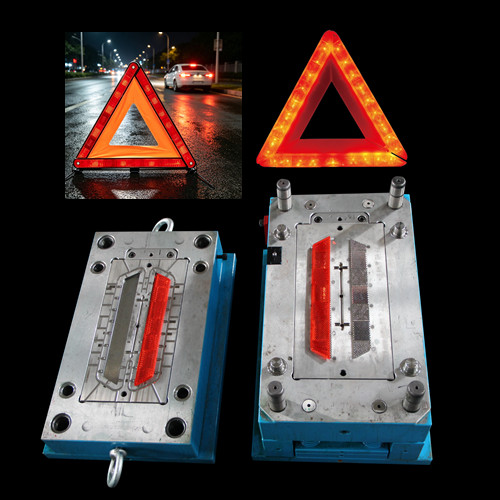
We are a professional mold manufacturer in Huangyan, China, specializing in high-precision injection molds for parking reflex reflectors and warning triangles. Our molds are made with durable steel for long service life, supporting custom designs and stable mass production to meet your automotive accessory manufacturing needs.
Parking reflex refletcor warning triangle mould