Why Choose Die Casting Mold Parts?
Die casting is a highly efficient and precise manufacturing process widely used across industries, especially in automotive, aerospace, electronics, and consumer goods. Among various die casting types, die cast aluminum mold stands out due to its lightweight properties, high thermal conductivity, and excellent corrosion resistance.
What Is a Die Cast Aluminum Mold?
A die cast aluminum mold is a specialized tool used in the high pressure die casting (HPDC) process to shape molten aluminum into complex, high precision components. Unlike traditional sand or permanent molds, die casting molds are typically made from hardened steel and are designed for high volume production with tight tolerances and smooth surface finishes.
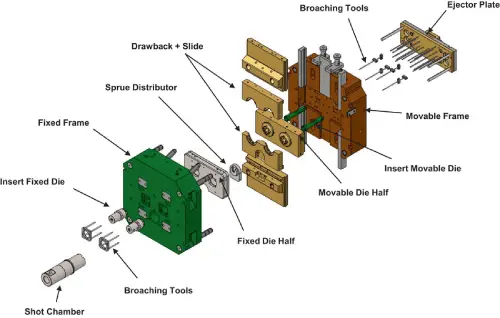
The mold itself consists of two main halves: the fixed half attached to the injection side of the machine and the moving half that opens after each cycle. Each mold is custom-engineered based on the geometry, function, and material requirements of the final part.
The Importance of Proper Die Casting Mould Design
The success of any die casting project hinges largely on the quality of the die casting mould design . A well designed mold ensures:
Uniform filling of molten metal
Efficient cooling systems to prevent warping or shrinkage
Optimal gate and runner system for material flow
Longevity under high pressure and temperature cycles
In the case of die cast aluminum mold , designers must account for aluminum's specific characteristics—low density, high fluidity, and moderate melting point—which influence cavity layout, venting, and ejection mechanisms.
Younger Mould excels in creating precision die casting mould designs tailored to each client's product specifications. With years of experience and a team of seasoned engineers, we integrate simulation tools like MAGMASOFT and ProCAST to optimize mold performance before manufacturing even begins.
Core Elements Found in Die Casting Mold Parts
Understanding the structure and function of die casting mold parts is essential for anyone involved in the design or procurement of molds. Here are the key components you'll find in most die cast aluminum mold systems:
1. Cavity and Core Inserts
These are the heart of the mold where the part shape is formed. They are usually made from high-grade tool steel and subjected to heat treatment for durability.
2. Sprue Bushing and Runner System
This system directs molten metal from the injection sleeve into the mold cavities. The design of the sprue bushing and runners affects the filling speed and pressure distribution.
3. Gates and Overflows
Gates control the entry point of molten metal into the cavity. Overflows collect excess material and help trap impurities and air bubbles, improving part quality.
4. Cooling Channels
Efficient cooling is crucial in maintaining mold life and part consistency. Cooling channels are strategically placed around the cavity to regulate temperature during the cycle.
5. Ejector Pins
After solidification, ejector pins push the finished part out of the mold. Their placement and quantity depend on the complexity and size of the part.
6. Venting Systems
Vents allow trapped air to escape during the filling phase, preventing porosity and defects in the final castings.
At Younger Mould, a die casting mold company, each component of the die casting mold parts is manufactured using CNC machining, EDM, and other precision techniques to ensure dimensional accuracy and long service life.
Materials Used in Die Cast Aluminum Mold Construction
Selecting the right material for mold construction is vital to ensure longevity and efficiency. Common materials include:
H13 Tool Steel : Widely used for its excellent hot hardness, wear resistance, and thermal fatigue resistance.
Maraging Steel : Offers higher toughness and polishability, ideal for high-precision molds.
Pre-hardened Steel : Often used for low to medium volume production runs to reduce cost.
In addition to the base materials, surface treatments such as nitriding and PVD coating are applied to enhance wear resistance and reduce sticking or erosion caused by repeated contact with molten aluminum.
Younger Mould carefully selects materials based on the expected production volume, complexity of the part, and operating conditions, ensuring that our clients receive molds that offer both performance and value.
Factors Influencing Die Casting Mould Design Complexity
Several variables can affect the complexity and cost of die casting mould design . These include:
Part Geometry and Undercuts
Complex shapes and undercuts often require side cores or slides, increasing mold complexity and cost. Standardizing features and minimizing internal threads or bosses can simplify mold making.
Tolerances and Surface Finish Requirements
Tighter tolerances demand more precise machining and careful material selection. High-quality surface finishes may require additional polishing or texturing steps.
Production Volume
High volume production justifies the use of premium materials and modular designs for easy maintenance. Low-volume jobs might benefit from simplified designs and lower-cost materials.
Thermal Management
Properly designed cooling channels and insulation layers help maintain consistent mold temperatures, which is especially important for die cast aluminum mold due to the fast solidification rate of aluminum alloys.
Companies like Younger Mould leverage decades of experience and modern simulation tools to balance these factors effectively in every die casting mould design project.
How Younger Mould Approaches Die Cast Aluminum Mold Development?
As one of the top tier die cast aluminum mold manufacturers globally, Younger Mould follows a structured and collaborative approach when developing new molds:
1. Initial Consultation and Feasibility Study
We begin by working closely with clients to understand their product goals, target application, and performance criteria. Our team conducts a feasibility study to assess manufacturability and identify potential risks early in the design phase.
2. 3D Modeling and Simulation
Using CAD software such as SolidWorks and AutoCAD, our engineers create detailed 3D models of the mold and simulate the casting process to detect possible issues like air traps, shrinkage, or poor filling.
3. Prototype and Testing
Before full scale production, we often produce prototype molds or machined samples to validate dimensions and functionality. This helps reduce time-to-market and ensures alignment with client expectations.
4. Precision Machining and Assembly
Our state-of-the-art facilities employ high-speed CNC machines, wire EDM, and surface grinding equipment to manufacture all die casting mold parts with micron-level precision.
5. Quality Control and Packaging
Each mold undergoes rigorous inspection using coordinate measuring machines (CMMs), hardness testers, and visual checks before being assembled and shipped to the client.
Challenges in Die Cast Aluminum Mold Manufacturing
Despite its advantages, die casting aluminum presents several technical challenges that must be addressed during mold design and manufacturing:
1. Thermal Fatigue Cracking
Repeated heating and cooling cycles can cause micro-cracks in mold surfaces. Using high-performance steels and optimizing cooling systems can mitigate this issue.
2. Soldering and Erosion
Aluminum tends to react chemically with some mold materials, leading to soldering (adhesion of metal to the mold surface). Applying protective coatings and choosing appropriate steel grades help reduce this risk.
3. Porosity and Shrinkage
Improper venting or cooling can result in voids or shrinkage defects in the final part. Careful planning of gates, overflows, and cooling passages during die casting mould design helps minimize these problems.
4. Dimensional Accuracy
Maintaining tight tolerances requires not only precision machining but also stable environmental conditions and regular maintenance of the mold.
Younger Mould addresses all these challenges through continuous improvement practices, investment in R&D, and close collaboration with end-users to refine processes and deliver superior results.
Future Trends in Die Casting Mould Design and Technology
The die casting industry is constantly evolving, driven by advancements in automation, materials science, and digital design tools. Some emerging trends shaping the future of die casting mould design include:
1. Digital Twin Technology
Creating virtual replicas of molds allows for real-time monitoring and predictive maintenance, significantly reducing downtime and increasing productivity.
2. Additive Manufacturing for Mold Cores
3D printing is being explored for producing complex internal geometries in mold cores that would otherwise be impossible or too expensive to machine conventionally.
3. Smart Sensors and IoT Integration
Embedding sensors in molds enables real-time data collection on temperature, pressure, and wear, providing valuable insights for process optimization.
4. Sustainable Practices
With growing emphasis on green manufacturing, molders are adopting energy-efficient systems and recyclable materials to reduce environmental impact.
As a forward thinking company, Younger Mould actively participates in global R&D initiatives and collaborates with academic institutions to stay at the forefront of innovation in die cast aluminum mold technology.
Investing in a high-quality die cast aluminum mold is a strategic decision that impacts product quality, production efficiency, and overall profitability. Whether you're looking for assistance with die casting mould design , manufacturing of individual die casting mold parts , or customized mold development, it's essential to work with a partner who combines technical expertise with proven execution capability.
Younger Mould has built a reputation as a trusted provider of precision die casting solutions, serving clients worldwide with reliable, durable, and cost-effective molds. By staying ahead of technological trends and focusing on continuous improvement, we continue to support the growth and innovation of industries reliant on die cast aluminum mold technology.
Younger Mould ranks is a die casting mold company, widely acknowledged for our exceptional quality, innovative solutions, and trusted reputation in the industry. Committed to excellence, we have built long standing relationships with clients across the globe. If you're seeking high quality die casting mold parts for automotive applications, please feel free to leave your contact details. Our dedicated team will provide you with competitive pricing and customized service to meet your specific needs.
How to Choose a Side View Mirror Mold?
Fender Moulds in Auto Mold Manufacturing
Related Article